
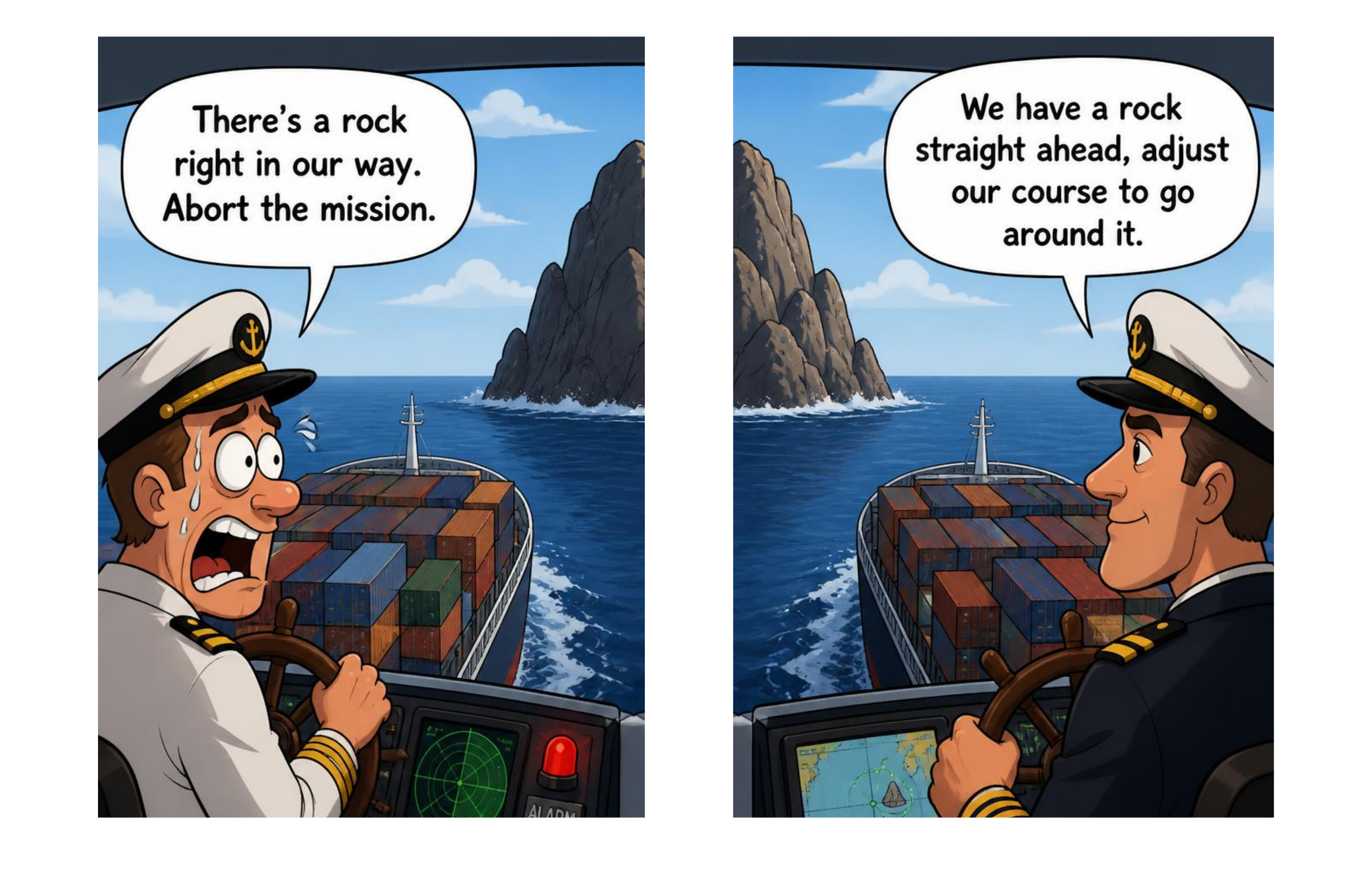
Reframing resistance as vital data and escaping the reactive trap.
Why would anyone abort a mission just because there is a rock ahead?
Sometimes the expectation of failure becomes a self-fulfilling prophesy, blinding us from seeing obvious paths forward.
Welcome back to our series on why promising initiatives stall or fail across K-12 education, business, nonprofits, and government sectors. Over the first three weeks, we’ve laid a foundation of structural and design-related barriers:
- Week 1: Falling into Solution Fixation and rushing to answers too quickly. (Read Part 1)
- Week 2: Searching for the non-existent “One Right Answer” and the fatal lack of a clear Theory of Change. (Read Part 2)
- Week 3: Mistakenly Excluding Implementers from design and confusing superficial Compliance with deep Commitment. (Read Part 3)
This week, we pivot to the deeply psychological and emotional landscape of change: how leaders handle friction, pushback, and their own reactive internal states.
Reason #6: Resistance Is Treated as Obstruction Rather Than Information
Picture this: I’ve just presented the new initiative to a group of employees. One person, the one who always seems to object, says, “That’s just like what we tried two years ago and it didn’t work then. Why don’t we just leave things they way they are rather than breaking them?”
What do you think my immediate reaction is; happiness at being able to engage or anger at this unexpected friction?
Why It Happens
Our survival brains react in hundredths of a second to possible threats, before we can even verbalize what happens (referencing our concepts from Week 1 and Week 2). That part of the brain interprets any pushback or “friction” as a direct challenge to authority, a potential for failure, and a threat to the leader’s ego.
This is where we default to our flawed mindsets from earlier in this series: we assume we have found the single, “one right answer,” so we judge any objection as expected resistance to change, laziness, stubbornness, or active sabotage on the part of the implementers. We view resistance purely as an obstacle we must defeat, bypass, or ignore to maintain project momentum.
This is a dangerous misinterpretation of the organizational landscape. While sometimes people do just object to change, a key leadership skill is to not just assume all objections are obstruction. When we react with defensive judgment, we are actively ignoring vital reality testing.
Example
A district introduces a new software platform designed to track student behavior, mandating that teachers input data live during class time. When teachers object, referencing past failures, administrators, feeling pressure, might label the group “obstructionist” or dismiss their concerns as typical pushback.
However, if those leaders used MindShifting skills like rapport building and open-ended questions to investigate the resistance, they might uncover a fatal logistical flaw. They would find that these teachers aren’t objecting to tracking behavior; they are objecting to a workflow that requires them to turn their backs on the class for two minutes after every minor incident, disrupting the learning environment for 30 other students.
Taking a pause, resetting from survival brain, and then using MindShifting communications skills might reveal an operational failure that will sabotage the entire initiative if ignored or perhaps make it evident that the objection is merely a red herring.
How MindShifting Helps
MindShifting resources help leaders transform their relationship with resistance, shifting from a reactive mindset of judgment (“Why are they so difficult?”) to a proactive mindset of curiosity (“What is this interaction revealing about our plan?”).
When we value resistance as necessary information rather than annoying obstruction, we gain crucial insight into where our implementation logic conflicts with operational reality. By using these insights to co-design adaptations with our teams, we build more resilient solutions. We shift from trying to push past people to investigating the friction and adapting the plan to fit the human and system environment.
Reason #7: Leaders Launch the Initiative from a Reactive Mindset
Why It Happens
Organizations—and the humans within them—tend to experience high anxiety when facing uncertainty, falling metrics, political pressure, or poor performance. In this reactive state, we feel a tremendous internal pressure to act now, think later. The entire initiative becomes driven by fear and urgency, which almost always guarantees that Solution Fixation (Reason #1) takes hold.
When we launch from a reactive mindset, we are often trying to alleviate our own anxiety as leaders by showing everyone we are “doing something,” rather than actually addressing the complex root cause of the problem.
Example
A business watches a competitor launch a new feature that grabs headlines. In a panic, the leadership team demands, “We need this feature too, and we need it now!” They rush out a version that actually slows down the workflow of their customers or that causes market confusion or that requires some amount of retraining that customers didn’t want or anticipate. It’s a survival response, not a strategic choice.
How MindShifting Helps
MindShifting articles, downloadables, and courses are designed to give leaders the perspective to make effective long-term decisions, plans, and implementations.
When we recognize that we are leading from anxiety, we can pause. Resilient mindsets help us make a conscious choice to step out of “fix-it-now” panic and back into “what is the real outcome we need?” curiosity. MindShifting gives leaders practical tools—including framing tools and the understanding of non-linear problems (Cynefin framework)—to navigate complexity without succumbing to the urge to force linear, reactive solutions.
Digging Deeper
To explore how to navigate multiple perspectives, build clearer models of organizational change, and understand why we default to reactive thinking, check out these related reads:
- Why We Struggle with Complexity and How to Get Better At It — Understanding why human brains default to simple (often reactive) fixes in complex systems.
- Why Simple Solutions Often Blow Up — Examining the ripple effects when we force single answers (and ignore the feedback) onto multifaceted problems.
Take Action: Build your leadership team’s internal capability to lead through anxiety, navigate complexity, and listen to diverse data without giving in to the urge for a quick fix. Join us for our comprehensive upcoming cohort starting this fall: Resilient Mindsets for Long-Term Success. All six sessions are included, providing a full leadership development path to sustainable initiative success.
Looking Ahead
Next week, we turn our attention to the human communication dynamics and psychological safety inside your organization:
- Reason #8: People do not feel safe reporting problems.
- Reason #9: Silence is interpreted as agreement.
Reflection for the week: Take a close look at the most recent pushback or objection you received regarding a key project. Was your first instinct to bypass it as an “obstacle” and defend your ‘one right answer,’ or did you access your resilient mindset and investigate the friction to find the useful data in that resistance?

Leave a Reply