
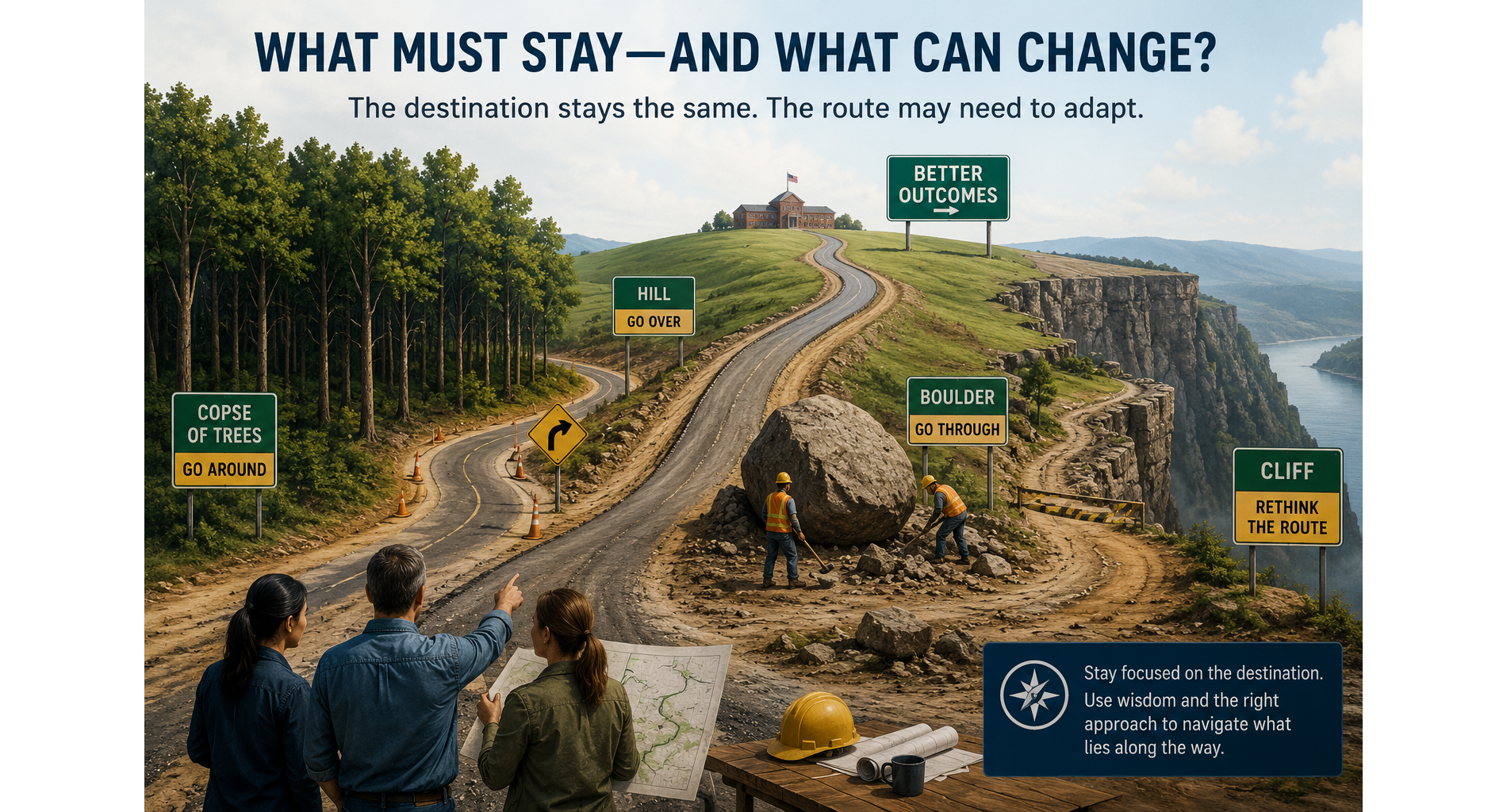
How education leaders (or any leader) can protect what makes an initiative work without becoming rigid about how it is implemented
Imagine your district adopts a promising new instructional approach.
The research is strong. Teachers have been trained. Leadership is committed.
Then reality intervenes.
No two schools, no two teachers, and no two classes are exactly the same. One teacher may lean toward project-based learning while another uses more direct instruction. One school may have more multilingual learners while another faces staffing limitations. Schools, classrooms, educators, and students are complex. Not every eventuality can be planned for in advance.
Sooner or later, someone asks:
Do we really have to do it this way?
That question can make leaders nervous. If everyone changes the initiative however they want, how can we know whether it is really being implemented—or whether it works?
But insisting that everyone follow every procedure exactly can create a different problem. Practices that work in one setting may not fit another. Educators may lose agency, develop workarounds, comply only when observed, or abandon practices that do not fit their students.
The challenge is not choosing between fidelity and flexibility.
It is figuring out:
What must stay—and what can change?
And then communicating those differences in ways that keep everyone as resourceful as possible.
Complex systems require adaptation
The Cynefin framework helps explain why this is difficult. Why Simple Situations Blow Up provides a short introduction to the framework.
Some situations are clear: cause and effect are predictable enough that established practices work.
Others are complicated: expertise and analysis can help us determine a good solution.
But organizational initiatives involving people operate largely in the complex domain. Teachers affect students. Students affect teachers and one another. Administrators, families, schedules, staffing, culture, resources, and previous experiences all interact.
We cannot know in advance exactly how those interactions will unfold.
In a complex situation, the approach cannot simply be:
Design the perfect solution and make everyone follow it.
It is closer to:
Establish a sound direction, act, observe what happens, learn, and adapt.
That does not mean everything is negotiable. Successful adaptation depends upon knowing what is not negotiable.
Some things are core
Every meaningful initiative has purposes, principles, or practices that make it effective.
Remove those, and you may no longer be implementing the same initiative.
Suppose a district creates collaborative teacher teams. Someone might assume the core requirement is:
Every grade-level team meets Tuesday from 3:15 to 4:00.
But Tuesday at 3:15 probably is not what improves instruction.
The essential elements might instead be that teachers regularly examine evidence of student learning, identify needs, share effective approaches, decide what to try next, and later evaluate what happened.
Those may be core.
The meeting day, agenda format, documentation system, group size, or technology may be adaptable.
Leaders can inadvertently defend a procedure when what they really need to protect is the mechanism that makes the initiative effective.
Different elements call for different conflict styles
The five conflict styles—Compete, Collaborate, Compromise, Accommodate, and Avoid—can help leaders decide how to respond.
MindShifting adds an important distinction:
Are we consciously choosing a style from a resourceful or Sage state, or falling into it from a limbic reaction?
Core elements may require Compete
If something is genuinely essential to the initiative’s ability to produce its intended outcome, leadership may need to be assertive. In Thomas-Kilmann terms, that may mean Compete.
But first, be careful about what you call core. Something is not core merely because it appeared in the original plan, leadership prefers it, or “that’s how the program is supposed to be done.” A core element should have a credible connection to how the initiative is expected to produce its results.
Return to the collaborative teacher-team example.
One school says:
“Tuesday afternoons don’t work for us. Could our teams meet Wednesday mornings instead?”
That sounds adaptable. Changing the meeting time does not undermine the mechanism of the initiative.
But another school says:
“We will hold the meetings, but we don’t want teachers examining evidence of student learning or coming back to see whether the changes they try actually worked. We want the teams to use that time to discuss the important issues of the day.”
Those may indeed be valuable conversations. But they are not necessarily accomplishing the same purpose.
If examining evidence of learning, deciding what to try, and returning to see what happened are part of what makes this particular initiative effective, eliminating them removes part of its core.
That may be a place for Compete.
But there is a major difference between limbic Compete and resourceful Compete.
Limbic Compete tends to be aggressive and unilateral:
“No. That’s the model. You’re required to follow it.”
We become certain, push our position, discount other perspectives, and treat resistance as something to defeat.
Resourceful Compete still protects the core, but uses empathy, exploration, and higher-level goals:
“I hear that there are other important issues your team needs time to discuss. Let’s look at how we can make room for those. At the same time, examining student learning, deciding what to try next, and coming back to see what happened are central to why we created these teams. How can we preserve those elements while addressing the other needs your team is facing?”
The leader has not surrendered the core requirement. But neither has the leader treated the other person as an opponent.
That is resourceful Compete: remaining firm about what is essential while bringing out the resourcefulness of everyone involved.
Adaptable elements invite adapable styles
When an element can change, Collaborate is often ideal:
“Given what we are trying to accomplish, how could this work best in your setting?”
The people implementing an initiative frequently know things its designers do not. Collaboration draws on that knowledge and increases agency.
But not every decision requires extensive collaboration.
Compromise may work when several acceptable options exist and a practical agreement is more important than finding the perfect solution.
Accommodate may make sense when the choice matters to the implementer but has little effect on the initiative’s success.
And sometimes Avoid—for now is resourceful. If we lack enough information, the wisest decision may be:
“Let’s learn more before we decide.”
The point is not to use one conflict style consistently. It is to choose the style that fits the situation.
The hardest part may be staying resourceful
This becomes difficult when someone challenges an initiative in which we have invested time, money, credibility, and political capital.
Someone says:
“This isn’t working.”
Our brain may hear:
You made a bad decision.
Meanwhile, the person implementing the initiative may hear leadership’s response as:
They aren’t listening to us.
Both sides can slip into limbic mode.
The leader’s resourceful Compete turns into fight:
“We’ve already decided this. Just implement it.”
A legitimate implementation concern can turn into:
“This whole thing will never work.”
Now useful information has become a battle over who is right.
MindShifting asks us to recognize that moment. Before choosing whether to Compete, Collaborate, Compromise, Accommodate, or Avoid, we need enough resourcefulness to choose rather than react.
Good leaders also help others stay resourceful—using empathy before persuasion, exploration before conclusion, questions before directives, and higher-level goals that remind everyone what they are ultimately trying to accomplish.
That includes not only those implementing the initiative, but also students, families, staff, and others affected by it. Their responses become part of the complex system too.
Four questions for deciding what must stay
For each important element of an initiative, ask:
1. What outcome are we actually trying to produce?
Not simply, What are we implementing? Ask what should become different because we implemented it.
2. What makes the initiative capable of producing that outcome?
Which principles or practices appear essential? If we removed this element, would we still have a credible reason to expect the initiative to work?
At this stage, you may not know with certainty. That’s fine. Start with your best hypothesis. Ask the people closest to implementation, examine the rationale behind the initiative, and be prepared to revise your thinking as you learn.
3. Is this essential—or simply how we originally planned to do it?
Schedules, forms, technologies, pacing, grouping, and procedures may matter without being core.
Ask:
Could we accomplish the same essential purpose another way?
4. What information would tell us whether an adaptation is helping?
Because the system is complex, sometimes we need to test rather than predict.
Make a reasoned adjustment. Observe what happens. Orient to what you learned. Decide what to do next. Act again.
That is an OODA loop—Observe, Orient, Decide, Act.
Try this with your initiative
Create three columns:
Must remain — our current hypothesis
What purposes, principles, or practices appear essential to producing the intended outcome? Why do you believe each is essential?
Can adapt
What can change in response to local circumstances while preserving those essential mechanisms?
We don’t know yet
What should be discussed, investigated, or tested before deciding?
Then ask:
What conflict style would help us handle each item resourcefully?
- Compete to protect something truly essential.
- Collaborate to develop a better local solution.
- Compromise when several workable choices exist.
- Accommodate when flexibility costs the initiative little.
- Avoid—for now when more learning should come before deciding.
The goal is neither rigid fidelity nor unlimited flexibility.
It is implementation integrity: protecting what makes the initiative effective while giving resourceful people enough latitude to adapt intelligently to circumstances nobody could completely predict.
And the moment we feel most certain that someone else “just needs to do it our way” may be exactly the moment to ask whether we are still resourceful enough to determine what truly must stay—and what can change.

Leave a Reply