
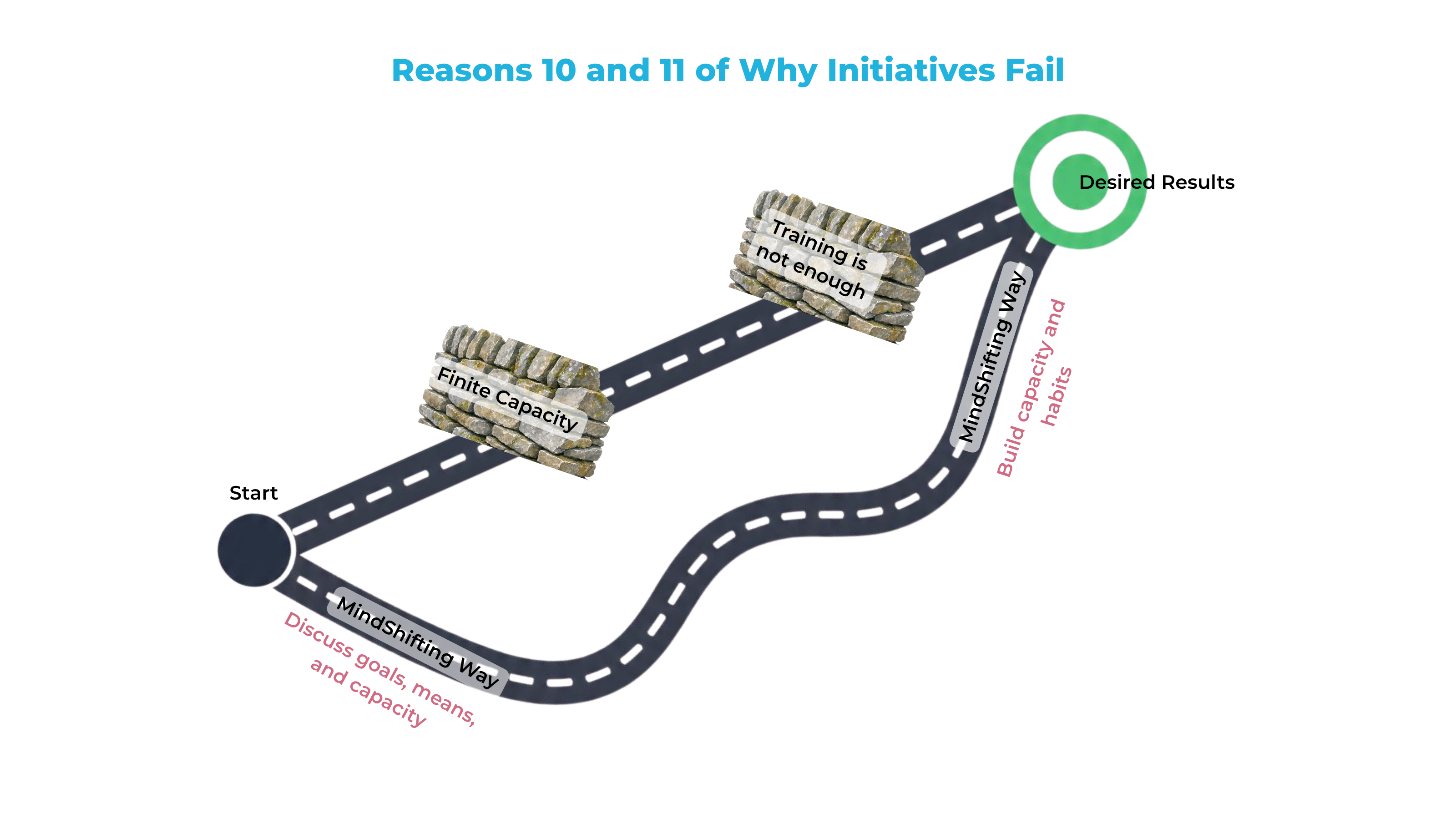
Leading Complex Change: Why New Initiatives Fail and How Mindsets Must Shift
Welcome to the sixth installment of our 8-week series examining the 15 systemic barriers that stall organizational transformation across K-12 education, businesses, nonprofits, and public agencies.
This week, we turn to the physical and cognitive realities of organizational capacity: how “one more task” limits success, and why teaching a skill is only the first step in adopting it.
Over the first five weeks, we explored how early mindset missteps compound over time:
- Week 1: Falling into Solution Fixation by rushing to implement answers before diagnosing the complex challenge. (Read Part 1)
- Week 2: Believing in the mythical “One Right Answer” and launching without an explicit Theory of Change. (Read Part 2)
- Week 3: Excluding Implementers from design and mistaking superficial Compliance for genuine Commitment. (Read Part 3)
- Week 4: Treating Resistance as Obstruction rather than diagnostic data, and launching from a Reactive Mindset driven by urgency. (Read Part 4)
- Week 5: Generating an informational vacuum where People Do Not Feel Safe Reporting Problems and Silence Is Interpreted as Agreement. (Read Part 5)
Reason #10: The Initiative Is Added Without Anything Being Removed
Why It Happens
Leaders often operate under the unconscious assumption that human bandwidth is elastic. When an urgent priority emerges, leadership rolls out a new platform, a revised pacing guide, or an additional reporting protocol. The announcement is usually accompanied by genuine enthusiasm for the expected outcomes.
What is missing from the rollout is an equally deliberate decision about what staff should stop doing.
When leaders layer new expectations onto an already packed workday, frontline professionals face an impossible equation. Teachers cannot invent a 25th hour in the day, nor can project managers absorb extra logging without sacrificing direct work.
We assume that resistance is a sign that people are resistant to change. Their resistance is often because they can’t take on additional work, their capacity is saturated, and we’ve made no accommodation for their workload. When that happens, they make their own trade-offs based on what they understand are priorities; they cut corners, bypass steps, or find ways to let the new initiative lapse simply to keep doing what they regard as “the work that matters.”
Overcoming the Barrier: A Case in Point
(Drawn from reflections shared by educators in MindShifting courses)
In a reflection from a MindShifting cohort, a project lead examined how to introduce a new Social-Emotional Learning (SEL) and community-building routine into their school district without overwhelming teachers. The project lead talked to school educators about workflows. This led her to map out three concrete options to manage the time trade-off:
- Compress existing instructional blocks to carve out a new time window.
- Explicitly remove an outdated administrative obligation to free up dedicated daily minutes.
- Re-engineer existing routines so the new skills are integrated directly into standard subject lessons rather than added as a separate task.
By analyzing the trade-offs in advance, the project lead recognized that stacking another standalone requirement onto the day would cause teachers to fall behind on core content. Choosing to integrate the skills into existing plans protected instructional pacing while ensuring the new practices actually occurred.
How MindShifting Helps
MindShifting equips leaders to discuss goals, means, and capacity with their teams. Meaningful dialog and system-wide engagement result from asking questions such as:
- “What legacy tasks, reports, or meetings can we eliminate to create room for this priority?”
- “If this new tool takes 15 minutes a day, what 15-minute obligation are we officially taking off their plates?”
When leaders take responsibility for clearing space, new initiatives become sustainable commitments rather than temporary burdens.
Reason #11: Leaders Treat Training as Implementation
Why It Happens
In many organizations, professional development is treated as an event rather than the start of the implementation cycle. An organization schedules an August kickoff, brings in an outside expert for a half-day presentation, distributes handbooks, and checks the box: “Training complete; initiative implemented.”
Many tech initiatives fail because people were trained in the features of the software, but weren’t guided on adjusting their professional practice.
Exposure to concepts is not the same as operational fluency. A three-hour workshop cannot rewire workplace habits formed over years.
When employees return to their regular tasks, the pressure of daily operations pulls them back toward familiar routines. When unexpected challenges arise, the newly introduced strategies feel awkward and inefficient. Without deliberate practice and coaching, staff revert to what is comfortable.
Leaders then misdiagnose this predictable return to habit as stubbornness or lack of buy-in, lamenting that “we trained everyone, but they won’t do it.”
Building new habits is an iterative practice, requiring practice, feedback, adjustment, and more practice. In truth, the organization delivered information without building the muscle memory needed to sustain it.
Overcoming the Barrier: A Case in Point
(Drawn from reflections shared by educators in MindShifting courses)
MindShifting teaches the value of effective iteration. While it is true that practice develops habit, it’s through deliberate practice that we improve. A resilient mindset is one that knows how to observe, use new and old information to propose possible actions, decide what to try based on an expected outcome, act, and then by observing the results, propose what to do next.
When leaders and staff view results as feedback rather than as judgment, engagement and persistence replace blame and resistance.
A classroom support leader shared an example of applying this distinction with a paraeducator who felt overwhelmed managing escalating student behaviors. The school had already provided standard behavior management training as part of their rollout, but in the heat of a chaotic classroom, the paraeducator felt constantly reactive and unable to apply the techniques.
Instead of treating the past workshop as sufficient, the team leader established an ongoing implementation routine:
- They maintained a consistent interaction log, normalizing missteps as diagnostic data rather than personal failure.
- They held short weekly coaching debriefs—the “slow loop”—to analyze specific behavioral triggers, evaluate what broke down, and rehearse alternative responses in a low-stakes setting.
- They practiced and refined these adjustments over several weeks until the new responses became automatic in the moment.
Because leadership provided a structure for continuous reflection and rehearsal, the paraeducator built genuine confidence and skill. Implementation did not happen during the initial training; it happened in the coaching structure that followed.
How MindShifting Helps
MindShifting helps leadership teams transition from event-based training to ongoing capacity building.
By applying MindShifting’s iterative improvement framework, leaders learn to pair initial instruction with protected time for deliberate practice, rapid feedback cycles, and peer coaching. Leaders stop asking, “Did everyone attend the training?” and start asking, “What ongoing support, reflection loops, and low-stakes practice have we scheduled to help staff turn these new ideas into everyday habits?”
Digging Deeper
To examine how to balance organizational workload and build long-term operational fluency, explore these resources:
- Why We Struggle with Complexity and How to Get Better At It — Strategies for designing workflows that match human capacity in complex environments.
- The Power of Iteration and OODA Loops — How slow, intentional reflection cycles build fast, reliable reflexes for leadership teams.
- Effective Problem Solving for Students and Adults — Practical tools for embedding collaborative problem-solving into daily routines.
Take Action: Develop your leadership team’s ability to prune obsolete work, coach for real competency, and implement lasting change. Join upcoming cohorts and workshops on the MindShifting Events & Courses Page.
Looking Ahead
Next week, we examine the risks of premature conclusions and flawed accountability metrics:
- Reason #12: Initiatives are abandoned before they have time to produce results.
- Reason #13: Leaders measure activity instead of systemic outcomes.
Reflection for the week: Look at your organization’s latest strategic initiative. What specific responsibility or routine did you officially remove to make room for it—and what weekly practice structure is in place to help your team master the new skill?

Leave a Reply