
Before trying to change another person’s behavior or solve the problem in front of you, make sure you are in a mental state capable of solving it.
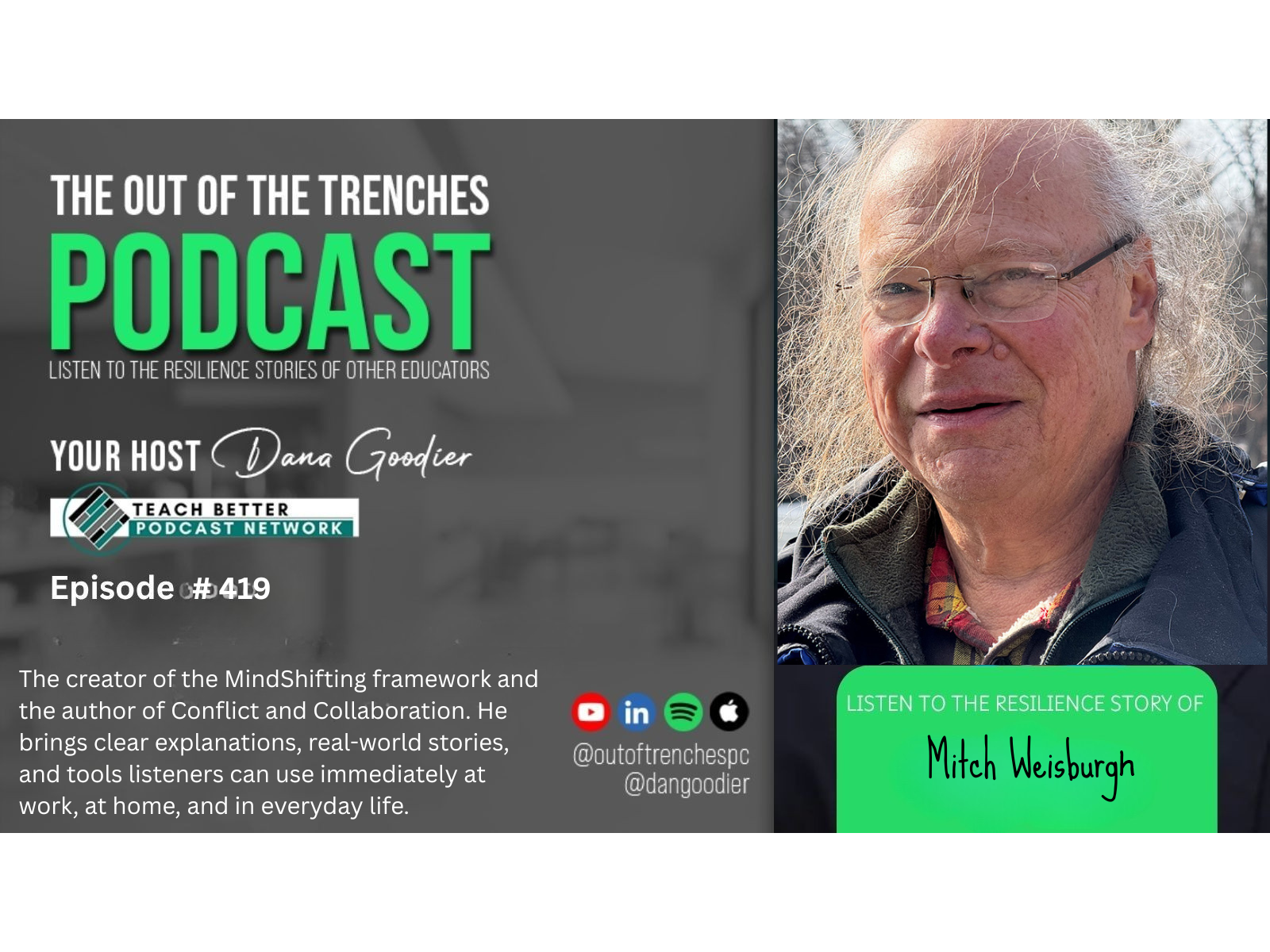
That was the central theme of a conversation I recently had with Dana Goodier on her Out of the Trenches podcast.
Dana uses her podcast and book to share educators’ stories of coming “out of the trenches”—how they have navigated challenges in education and developed the resilience to thrive. In our conversation, we explored why smart, capable, well-intentioned people can still make poor decisions, escalate conflicts, and use approaches that work against what they are trying to accomplish.
We touched on eight ideas:
- Not every problem has one right answer.
- Expertise is valuable, but experts shouldn’t automatically determine the solution to complex problems.
- Under threat, the brain shifts from resourceful thinking to reactive thinking.
- Conflict often isn’t really about the issue being discussed.
- You can de-escalate conflict without surrendering authority.
- Motivation is less about willpower and more about alignment.
- Burnout needs to be addressed before someone becomes completely overwhelmed.
- Prepare for difficult conversations rather than relying on yourself to improvise while triggered.
I want to dig a little deeper into #4, because it helps explain why so many conversations go wrong even when both people have legitimate concerns.
When the argument stops being about the argument
At one point Dana observed, “Often when people at work have difficult conversations, sometimes these conversations tend to spiral despite good intentions.”
Despite good intentions, that’s important.
Suppose a principal announces a new instructional policy. A teacher hears it and immediately thinks:
They don’t trust my judgment.
Or a teacher talks with a parent about a student’s missing assignments, and the parent hears:
You’re saying I’m a bad parent.
Or a colleague questions a proposal you’ve spent weeks developing, and what registers in your brain is:
They’re attacking my competence.
The conversation may appear to be about the policy, the assignments, or the proposal. But something else has happened.
The brain has detected a threat.
As I explained to Dana, when we move into that reactive state, “you lose the ability to then say, ‘Well, wait a minute…maybe he’s 10% right.’”
That may sound like a small thing, but it is enormously important, and it occurs frequently in our conversations at school, at work, at home, with anyone we try to influence, persuade, coach, or advise.
The term limbic mode describes what happens when our survival-oriented systems begin driving our response. Fight, flight, freeze, following what others are doing, or falling back on familiar habits can take over remarkably quickly.
The term sage mode is when the brain is not treating the situation primarily as a threat. That gives us greater access to the capacities we need for good judgment: perspective, empathy, curiosity, creativity, and flexible problem-solving. Instead of automatically defending ourselves or falling back on familiar responses, we can pause, consider what else might be true, recognize the other person’s point of view, and choose a response based on what is most likely to help rather than what feels most immediately protective.
When limbic mode happens, we lose access to some of the capabilities we most need: perspective, empathy, curiosity, creativity, and flexible problem-solving.
Now imagine what happens when both people react this way.
One person feels threatened and responds defensively. That response feels threatening to the other person, who becomes defensive in return. The first person experiences that reaction as further evidence that the other person is unreasonable.
Pretty soon, two intelligent, well-intentioned people can be fighting about something quite different from the issue that originally brought them together.
This is why one of the most useful things we can learn during conflict isn’t a brilliant argument.
It’s self-awareness.
Near the end of our conversation, Dana asked me for the one thing I most wanted listeners to remember. My answer was:
“Self-awareness is the key first step.”
When I notice that a conversation isn’t going well, one of the questions I try to ask myself is:
Could I be in limbic mode right now? How could I get into sage mode?
Sometimes merely recognizing it changes what becomes possible. Instead of concentrating on how to prove the other person wrong, I can become curious. Instead of preparing my rebuttal, I can listen. Instead of asking, How do I get this person to agree with me? I can ask, What am I missing?
That doesn’t mean giving in, abandoning authority, or pretending every position is equally good.
It means getting yourself into a state where you are actually capable of making a good decision about what to do next.
Dana and I explored these ideas in much more depth in our conversation on Out of the Trenches.
Watch the full interview here:
https://youtu.be/kV9soU8BCtk?si=igy3TZrMer5_Osg7

Leave a Reply