Is there anyone you know who is happy about the way society-wide systems are working today? Healthcare, education, government, communication, media, transportation, safety, job security, it’s like one broken system after another, and they all seem conspiring against our happiness and world peace.
This will be a two part series and was inspired by a web meeting I was part of where Ulcca Joshi Hansen presented.
Here is the first paragraph of her bio:
ULCCA JOSHI HANSEN is an author, educational thought leader and social change advocate with a twenty-year career dedicated to shifting the foundational values and approaches that undergird America’s education system. She currently serves as the Chief Program Officer for Grantmakers for Education, a member organization that serves as a trusted partner for education philanthropists as they adapt to the changes impacting our world.
I was in the web meeting because I am part of a book study group, and our next book discussions will be around her The Future of Smart: How Our Education System Needs to Change to Help All Young People Thrive.
She wrote this book in 2021, and the web meeting covered her thoughts on society, the world, and education after the book was published.
We are all in a state of anxiety, caused by existing in a constant state of VUCA: volatility, uncertainty, complexity, and ambiguity. Human beings are highly uncomfortable in that environment, our brains find safety in certainty. That’s a big part of what’s making us miserable.
Why are we in that situation, and what’s going to bring us out?
This post will be about the why, the causes. The second article will be about the way(s) out.
The Rise and Fall of Systems and Institutions
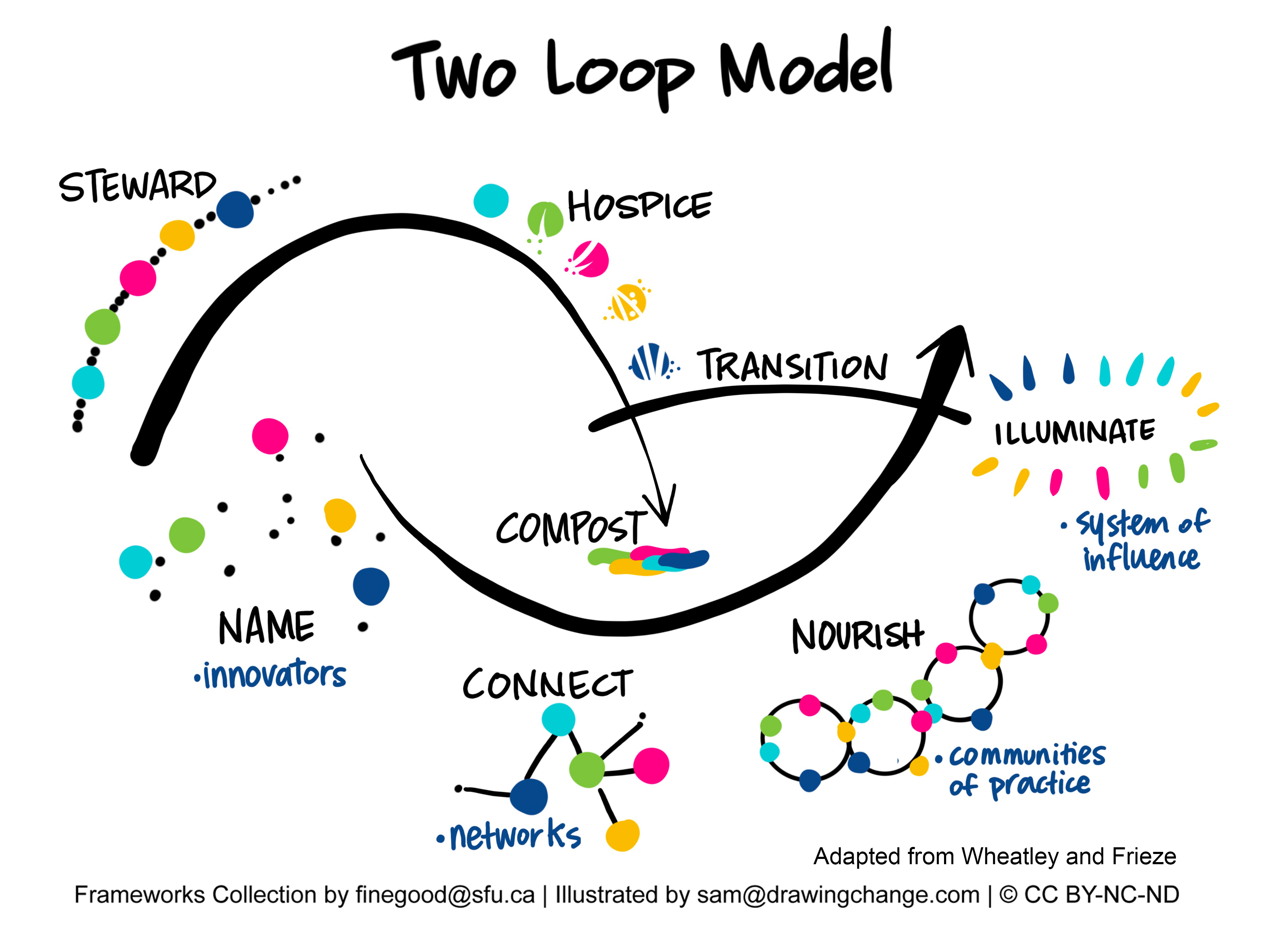
Dr. Hansen frames our times in terms of the Berkana Institute’s Two Loop model for systems change.
At the top left are the usefulness trajectories of dominant systems. As the systems are stewarded, they become more and more useful and more and more widespread. Then, at some point, they start declining, efforts to revive them are more like hospice than repair. Where are we now? Systems that seemed to work for the first 75 years of the twentieth century just aren’t serving us well today, and we are past the peak of the curve in states of decline.
While the dominant systems are declining, there is a burst of activity from innovators, but most innovations also do not survive. Then at some point, a few of them start growing, the islands of coherence start nurturing them, and communities of practice help them grow. This is a period of transition, and at some point light is shed on their success and the surviving practices become dominant. New systems only emerge after the old ones are moribund, dead, or compost.
What the Cycles of History Tell Us
We are in that decline of the dominant systems now, and Dr. Hansen used Neil Howe’s The Fourth Turning to explain what we are going through. As systems decline, Howe avers they go through four turnings or phases.
At the top of the curve, there is a barely perceivable waning. This is the first turn, and characterized by the institutions doubling down by communicating what is working and why anything else is worse, while a small group of “outsiders” point out where we are going.
As the systems start down the curve, the second turning is when many are starting to realize things aren’t going as well as they expected. The systems react as if they are being attacked. People generally are happy as they feel that by recognizing the issues, society is moving to solve them.
The third turning is when things start unravelling. Support for existing institutions is eroded. People are cynical that anyone inside the institutions will solve their problems and latch on to people who communicate that they can change while the organizations themselves do what they can to resist changing.
Where we are now is approaching or inside the fourth turning, or crisis. People are desperate for new systems that will fix things, they are looking to join with others, to build community, and their time horizons are shortened to what they need to do to survive; the practical not the strategic. In the Two Loop Model, our systems and institutions are in hospice, attempts innovation are failing. We aren’t seeing a way out. Our fears and anxieties are fed by VUCA.
How did we get here?
Both Mihaly Csikszentmihalyi and Dave Snowden, among others, have pointed out that the systems and beliefs that bring success very often grow sclerotic to become the systems that bring about our destruction. Dr. Hansen pointed out that’s basically what has happened with rationalism. She calls this the Cartesian-Newtonian world view, or rationalism, and it brought about manufacturing, medicines, education, increased standards of living, and capitalism.
Rationalism is what the military and government strategist John Boyd would call analysis. In the Orient stage of his OODA loops, analysis is breaking things down into their constituent parts, forecasting trends based on existing data, measuring and using data. It’s a foundation of B F Skinner behaviorism, only what can be measured or observed counts.
Dr. Hansen notes that rational thought is only half of the way the brain makes sense of situations. The left parts of people’s brains operate this way, but the right parts of the brain are more holistic. In cases where the sum is different from the whole, or where results cannot be controlled, analyzing or taking things apart isn’t enough.
John Boyd maintained that we need analysis AND synthesis. Synthesis is putting things together as part of innovation or dealing with situations that cannot be controlled, that are unpredictable, or that are complex. Dr. Hansen calls this holistic-indigenous thinking
Classical economics was based on rationalism; money is easily measured and analyzed and classical economics assumes everyone makes rational decisions that are based on increasing their money. An alternative to classical economics that has proven more likely to predict behavior is behavioral economics, treating people as complex decision makers. Behavioral economics tends to be holistic.
Hierarchical/linear structures for business and systems are rationalistic. The pyramid organization chart with the boss on top and all the workers on the bottom is an example. Networked structures are holistic. John Boyd showed you need both for a modern military. You need people at the center to make strategic decisions, but you also need dispersed, networked, holistic information flow and decision making to respond to local actions.
Newtonian physics is rationalistic. Quantum physics is holistic. Healthcare as interventions to prevent death or ameliorate symptoms is rationalistic, health as wellness is holistic.
Where Do We Go Next?
Dr. Hansen points out that because our institutions, economics, and society have been overly based on left-brain thinking, they haven’t been able to adapt and they are breaking. Because we have been conditioned to think with our left brains, to break things down but not to perceive complexity, we don’t have the paradigms or models to adapt. Developing the awareness of complexity, the ways of thought to synthesize and not just analyze, and the systems and organizations to allow us to be at equilibrium will take time, maybe even a generation. The right brained traits we need to focus on are
- The ability to manage ambiguity
- Recognizing interdependence and mutuality
- Knowing how to learn
- Self-awareness and metacognition
- Discernment without judgment
- Engaging with ethics and values
- Empathy
- Collaboration
How this happens in society and as individuals is a post for next week.

Leave a Reply