
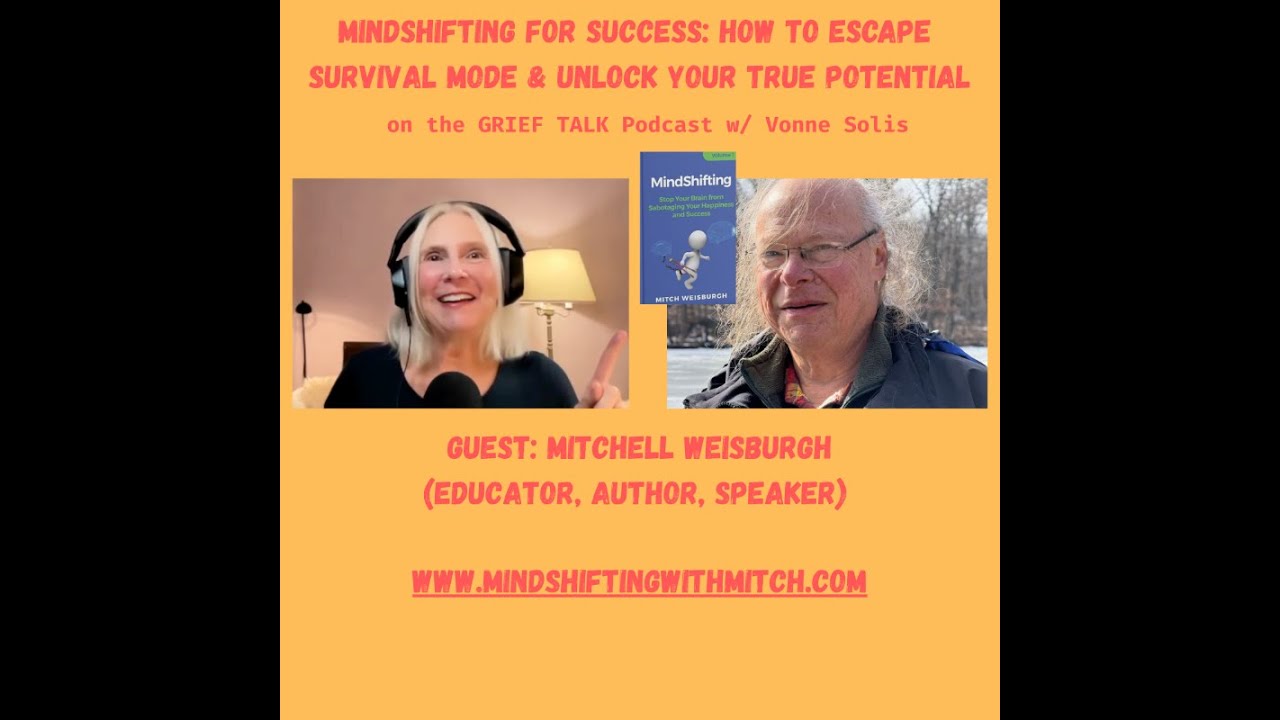
I recently had a fantastic, deep-diving conversation with Vonne Solis on her Grief Talk podcast.
You might wonder why a grief podcast, but as Vonne points out, the concepts of MindShifting are crucial when dealing with any major adversity, loss, or time of feeling stuck. We explored how to build true resilience and resourcefulness, and how the ancient functions of your brain are often what hold you back from living a happier, more productive life.
If you’ve ever felt like your own mind is your worst enemy, you’re not wrong—but the truth is, your brain can also become your best friend.
The Truth About Resourcefulness and Resilience
We often think of resourcefulness as something we magically tap into when we need it, but it’s a muscle that needs exercise. True resourcefulness means having the ability to recognize, first and foremost, when you’re stuck, and then knowing that you have the tools to pull yourself out of that state. It’s an active choice, a capacity you build to avoid getting trapped in limiting patterns.
Similarly, resilience isn’t just about “bouncing back” with grit; it’s about reframing your experiences. It’s the ability to look at any situation, good or bad, and view it not as a success or a failure, but as feedback. Think of it as if you were a curious scientist running an experiment: whatever the results, each attempt is actually valuable data that informs your next action. This mindset shift allows you to move forward confidently, knowing you have the capacity to figure out what to do next, by yourself or with others6.
Your Brain’s “Red Alert” Mode
Why is tapping into these mindsets so difficult? Because we are all operating with a “fast-and-furious” part of our brain; what many of us call the survival brain, which scientists refer to as the limbic system.
The limbic system is one of the oldest, most foundational part of your brain, and it evolved for one purpose: to keep you alive. It’s incredibly fast, waking up and reacting to any stimulus (a perceived threat, a thought, or a verbal comment) in about two one-hundredths of a second. When triggered, it focuses the entire organism on immediate action and chooses from five types of survival-driven behaviors:
- Fight, Flight, and Freeze: The classic three Fs, which developed to deal with physical threats.
- Ingrained Habits: Actions you can perform without thinking, like walking, driving, or automatically replying “Fine” when someone asks how you are—even if you’re not fine.
- Following the Group/Tribe: The immense pressure we feel to copy or conform to what the people around us are doing.
If you’re procrastinating, snapping at a loved one, feeling anxious, or saying “yes” when you desperately want to say “no,” you’re likely operating from this powerful, ancient, limbic system mode.
Shifting from Survival to Resourceful Mode
The good news is that we have another part of the brain: the resourceful brain, or the prefrontal cortex. This is where critical thinking, creativity, empathy, and executive function reside. The problem? It’s slower. It “wakes up” in about two to three seconds after the limbic system has already taken over.
The secret to MindShifting is you can’t fight the limbic system, you have to find ways to calm it down and trick it into giving your resourceful brain a chance to take control. You do this with a toolkit of self-intervention techniques:
- Self-Awareness: Simply recognizing, “Oh my gosh, I’m in limbic mode”. Sometimes, simply naming the state is enough to defuse it.
- Positive Self-Talk: Don’t argue with your inner Saboteur! If you hear the voice saying, “I can’t,” don’t counter with “I can”; that just causes a fight. Instead, use language that opens up possibilities, such as “Perhaps I can”. This simple phrase immediately lowers the pressure and allows your resourceful brain to start exploring solutions.
- Distraction: Engage in activities that actively calm your limbic system and reduce stress hormones23. This includes mindfulness, meditation, breath work, or even something physical like dancing or taking a walk in nature.
The power to shift is within you. By applying these simple tools, you can disrupt the automatic programming of your survival brain and access the critical thinking and creativity you need to deal with any situation—whether it’s everyday friction or major grief and adversity.
Learn More and Continue the Conversation
I encourage you to listen to the full interview with Vonne Solis on the Grief Talk podcast (below) to hear more about how MindShifting works, how to use MindShifting to overcome grief, and how to tap into your own resourcefulness and resilience.
The full interview includes the different styles of conflict resolution (compete, accommodate, avoid, compromise, and collaborate) and the importance of co-regulation
Visit my website MindShiftingWithMitch.com, where you can explore the techniques, read the blog, and find links to my books, including MindShifting: Stop Your Brain from Sabotaging Your Happiness and Success and the upcoming book, MindShifting: Conflict and Collaboration.

Leave a Reply