Picture a classroom where both teacher and students suddenly find themselves stuck—stress rising, frustration mounting, and learning grinding to a halt. We’ve all been there. But what if there were tools that could flip the script in those very moments?
In the fourth session of our current MindShifting course, MindShifting: Mastering Your Resourceful Brain, instructor Jane Lyons brought this challenge to life and introduced two powerful techniques that help turn reactive moments into opportunities for resourcefulness and growth.
The Interrupter and Self-Commander, core tools of the MindShifting methodology, give both teachers and students practical strategies for accessing their most resourceful mental states—even under stress.
First…Understanding the Brain’s Default Reactions
When we face stress or perceived threats, the brain’s limbic system kicks in with its familiar defaults: fight, flight, or freeze.
For educators, day-to-day triggers of these defaults might include frustration with disruptive students or anxiety about administrative demands.
For students, triggers might include common test anxiety or feeling overwhelmed by difficult material.
Lyons explained that these default reactions are often tangled up with cognitive dissonance—the discomfort we feel when our actions don’t line up with our beliefs.
Teachers experience it when their vision of how their classroom experience should be contrasts with the experienced reality.
Students feel it when their self-image as “capable learners” conflicts with struggles to grasp new concepts.
Layer in cognitive biases like confirmation bias, and the problem deepens.
Teachers may only notice behaviors that reinforce existing perceptions of a student.
Students may fixate on mistakes instead of progress, or only perceive their successes and not their gaps.
These biases aren’t flaws—they’re shortcuts the brain uses for efficiency—but they can undermine both teaching and learning.
So, how do we move beyond these defaults and toward a better teacher–student communication structure?
Enter the Interrupter…
The Interrupter: A Self-Awareness Gateway
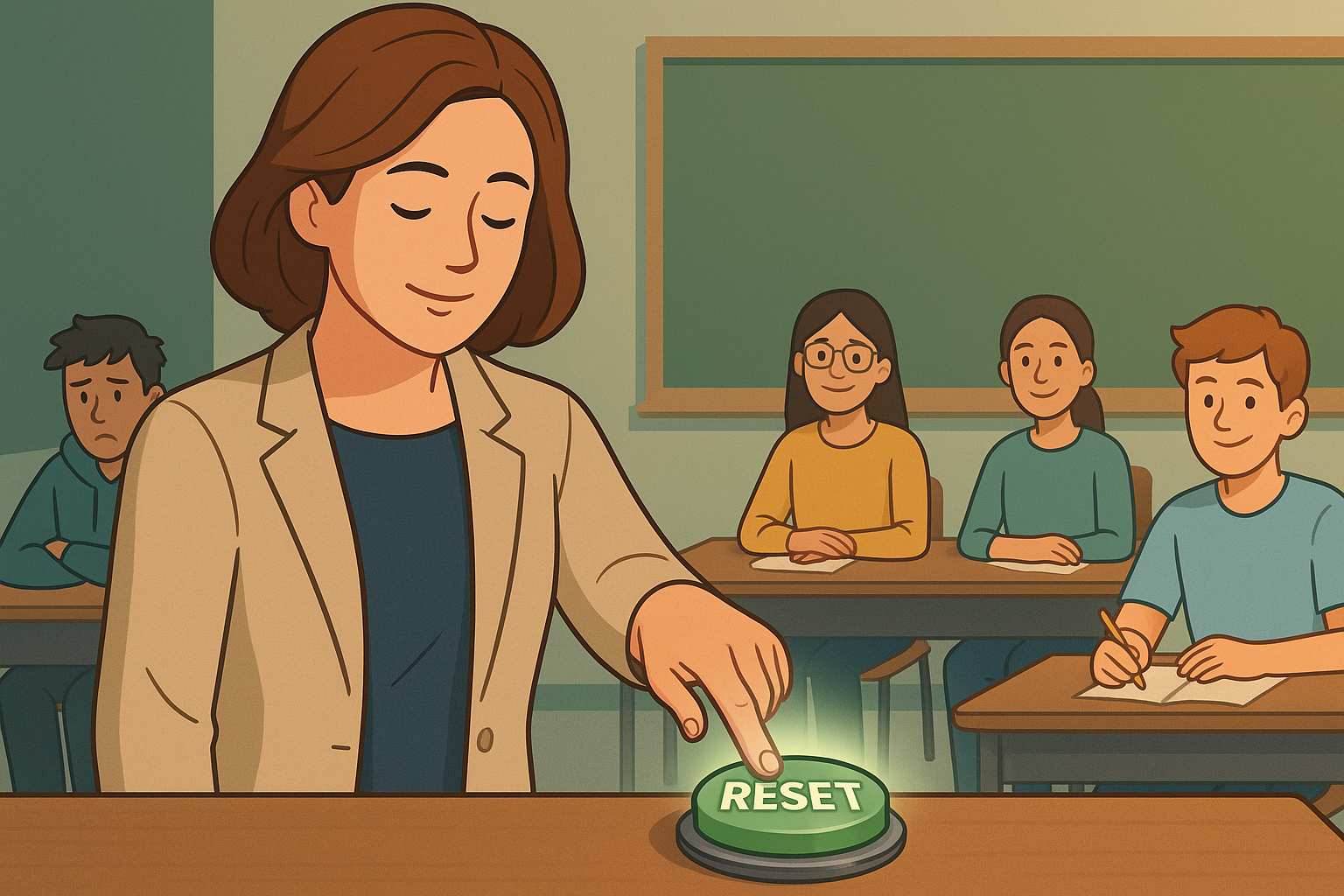
The Interrupter is a MindShifting technique introduced to break those default limbic reactions described above. It serves as a reset button—pausing the automatic fight, flight, or freeze responses so teachers and students can step into a more resourceful state.
The Interrupter is all about awareness. It doesn’t change your mental state—it simply shines a light on the fact that you’re stuck in “saboteur mode” (limbic dominance).
That awareness might show up as:
- A teacher noticing tension in their shoulders or a racing heartbeat during a tough class.
- A student recognizing sweaty palms or catastrophic thoughts before an exam.
As Lyons put it: “You cannot change what you cannot see.”
The goal of the Interrupter is to make the invisible visible. It doesn’t solve the problem, but it opens the door to the next step.
The Self-Commander: Choosing a Shift
Once the Interrupter creates awareness, the Self-Commander can step in.
Think of it as the brain’s “executive function.” Where the Interrupter says, “I’m in limbic mode,” the Self-Commander says, “I choose to shift into resourceful mode.”
- For educators, this might mean stepping back from frustration and accessing curiosity instead.
- For students, it could mean redirecting attention away from anxious thoughts and toward problem-solving.
The Self-Commander cannot function without the Interrupter. First you notice the state you’re in. Then, and only then, can you choose to move into a more resourceful one.
Putting It into Practice
Lyons shared examples of how these two techniques work together:
- A teacher feels frustration rising (Interrupter) and then deliberately shifts into curiosity (Self-Commander).
- A student notices test anxiety creeping in (Interrupter) and then redirects focus toward recalling study strategies (Self-Commander).
Teaching these steps openly helps students and teachers alike realize they can move from reactive to resourceful—but only if they first recognize what’s happening inside their own brains.
Transforming Classrooms
When both educators and students learn to use the Interrupter and Self-Commander, the classroom changes.
Instead of environments dominated by stress and reactivity, schools become places where creativity, compassion, and resourcefulness can thrive. Lyons calls this the “sage mind”—our highest mental state, where we are at our most capable and resilient.
Practical Steps for Educators
Lyons closed the session with practical suggestions:
- Start with yourself—master the techniques personally before teaching them.
- Build short mindfulness practices into the start of class to strengthen the Interrupter.
- Explicitly name limbic reactions when they arise and model how to shift with the Self-Commander.
Over time, these small practices cultivate resilience, flexibility, and creativity—the very skills students need to succeed in today’s complex world.
Ready to Go Deeper?
These techniques are explored in depth in the MindShifting: Mastering Your Resourceful Brain course and in MindShifting: Stop Your Brain from Sabotaging Your Happiness and Success.
—
About MindShifting with Mitch Weisburgh
MindShifting is transforming how individuals, teams, and organizations unlock their full potential—whether in the classroom, the boardroom, or personal growth journeys. Developed by educator, author, and thought leader Mitch Weisburgh, MindShifting combines the latest insights from psychology, neuroscience, and practical experience to help people overcome barriers, shift mindsets, and achieve lasting results.
Through his writing, keynote talks, and engaging workshops, Mitch empowers educators, corporate teams, and life coaches to embrace new ways of thinking and problem-solving. His unique MindShifting framework provides practical tools for building resilience, resourcefulness, and collaborative skills that drive real-world change.
To continue your exploration of MindShifting, visit www.mindshiftingwithmitch.com.

Leave a Reply