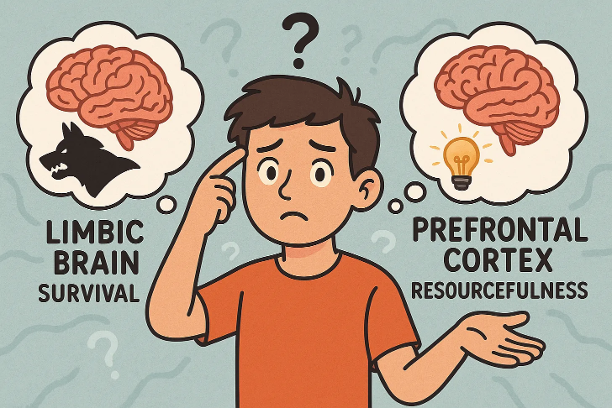
In the high-stakes world of work, our brain’s primitive survival mechanisms can often hold us back from peak performance. The limbic system – that ancient part of our brain responsible for fight, flight, and freeze responses – can sabotage our ability to think creatively, solve problems, and connect effectively with clients and colleagues. When we’re stressed, our prefrontal cortex (the center of critical thinking and executive function) gets disabled. Cortisol and adrenaline flood our system, narrowing our perspective and limiting our problem-solving capabilities. But there are powerful strategies to overcome these mental barriers.
Three Key Strategies to Unlock Your Mental Potential:
Self-Awareness
The first step is recognizing when you’re stressed. Simply acknowledging your emotional state can begin to calm your limbic system. By becoming aware of your mental state, you create space between your reactive emotions and thoughtful response.
Positive Self-Talk
Replace limiting thoughts with empowering language. Instead of “I can’t do this,” try “Perhaps I can” or “What would be the best way to approach this?” These subtle linguistic shifts can open up new mental pathways and possibilities.
Strategic Distraction
Take short breaks to reset your brain. Meditation, a brief walk, listening to music, or engaging in a quick hobby can help recalibrate your mental state. Even 30 seconds to 5 minutes of mindful distraction can restore your cognitive flexibility.
Consider implementing a morning meditation routine. Just 10-20 minutes can provide mental fuel for the entire day. During high-stress moments, even a two-minute mindfulness break can help you regain composure and access your most strategic thinking. Remember: Your brain is plastic.
Bonus Technique: Co-Regulation
You thought you were getting three, but here’s a fourth. No extra charge.
When self-regulation feels challenging, don’t hesitate to seek support from a trusted colleague or mentor who can help talk you down and provide perspective. For high stress, high anxiety situations, talking to someone else who can talk us off the ledge can be particularly crucial. When self-awareness, positive self-talk, and mindfulness don’t bring me back down, I call my son. Just having a knowledgeable trusted person to talk with can bring me back to a stage of resourcefulness.
When dealing with complex decisions or challenging interpersonal interactions, your ability to remain calm and creative can make the difference between closing a sale or losing an opportunity.
With practice, you can train yourself to move beyond survival reactions and into a state of resourceful, adaptive thinking. The key is understanding that the stories we tell ourselves about our capabilities are just that – stories. By questioning our assumptions and remaining open to possibilities, we can consistently perform at our highest level.
Whether you’re navigating Medicare options, closing a complex business deal, teaching a full class of recalcitrant students, or managing daily professional challenges, your mind is your most powerful asset. Learn to work with it, not against it.
—
About MindShifting with Mitch Weisburgh
MindShifting is transforming how individuals, teams, and organizations unlock their full potential—whether in the classroom, the boardroom, or personal growth journeys. Developed by educator, author, and thought leader Mitch Weisburgh, MindShifting combines the latest insights from psychology, neuroscience, and practical experience to help people overcome barriers, shift mindsets, and achieve lasting results.
Through his writing, keynote talks, and engaging workshops, Mitch empowers educators, corporate teams, and life coaches to embrace new ways of thinking and problem-solving. His unique MindShifting framework provides practical tools for building resilience, resourcefulness, and collaborative skills that drive real-world change.
To continue your exploration of MindShifting, visit www.mindshiftingwithmitch.com.


Leave a Reply