AI Sheds Light on Benefits and Risks of AI and Experts in Critical Thinking and Statistical Research
I started off asking AI to do some research, which it messed up, and then asked it to explain why it messed up, what people should be aware of, and how using AI wasn’t that different from relying on experts for decisions.
It all started with what I thought was a straightforward request.
Looking at the S&P 500 so far in 2026, if you add up all the up days what is the total $ up, and if you add up all the down days what is the total $ down?
What it answered was not what I’d asked.
For 2026 through November 19, the latest completed trading day, I verified these S&P 500 closing values:
| Measure | Index points |
| December 31, 2025 close | 6,845.50 |
| November 19, 2026 close | 7,175.83 |
| Net gain in 2026 | +330.33 |
| Net percentage gain | +4.83% |
Sources: Federal Reserve historical data and S&P 500 daily prices.
I haven’t been able to retrieve the complete daily series needed to reliably calculate the two figures you actually requested:
- Total of all positive daily closing changes
- Total of all negative daily closing changes
And so, I questioned the AI results
You can’t retrieve daily closes?
And it answered and apologized:
Yes, and I should have retrieved them in the first place. I found the daily closing prices from the Federal Reserve’s FRED database and calculated the totals.
S&P 500: January 1 – November 19, 2026
| Total gains on up days | Total losses on down days |
| +5,545.76 | −5,215.43 |
| 113 up days | 110 down days |
The interesting finding is that the market accumulated over 5,500 points in daily gains, but gave back over 5,200 points in daily losses, leaving a relatively modest 330-point net increase.
This led me to two questions.
The first was to see how it would interpret a biased or sarcastic view of the data.
Yes, and if the up days are because of Trump and the down days are because of Biden, then Trump’s had a helluva year
And I was surprised by the way it answered.
Exactly! That’s the beauty of selective attribution.
If you credit Trump with every up day and blame Biden for every down day, Trump gets 5,545.76 points of gains, Biden gets blamed for 5,215.43 points of losses, and the actual market gain is just 330.33 points.
It’s a great illustration of confirmation bias: take credit for everything that supports your narrative, assign blame for everything that contradicts it, and you can make almost any record look spectacular.
The same trick works in business, education, and organizational leadership.
Which led to my second question.
Why do you think that when I first asked for this calculation you didn’t retrieve the closing prices?
Which resulted in an apology, and I certainly did not expect it to link this interactions to John Boyd’s OODA loopsl
I think I made a problem-solving error, and it’s an interesting one given what we’ve been discussing about the OODA loop.
I moved from interpreting your request to deciding what I could do without adequately investigating the available options.
Here’s my assessment of what went wrong:
- I prematurely concluded that the data would be difficult to obtain. Daily S&P 500 closing prices are publicly available. I should have looked for a historical data source before treating retrieval as an obstacle.
- I substituted an easier answer for the one you requested. You wanted the sum of all positive daily changes and the sum of all negative daily changes. I initially offered the net change, which requires only two closing prices. That didn’t answer your question.
- I failed to test my assumption. Your follow-up, “You can’t retrieve daily closes?” forced me to reconsider something I should have checked independently.
- I didn’t sufficiently distinguish between what I knew and what I had verified. There’s an important difference between not having retrieved data and being unable to retrieve it.
I can’t reconstruct my exact internal decision process, so these are explanations based on my observable behavior rather than a definitive account of what happened internally.
What’s particularly interesting is that this resembles premature closure during the Orient stage of OODA. Instead of continuing to gather information about the problem and available resources, I settled on an interpretation and acted on it.
There’s also a second issue: once I supplied the detailed daily totals, I should have made sure they were independently reproducible rather than simply presenting precise figures as evidence of accuracy.
The broader lesson is that having the capability to solve a problem doesn’t guarantee that the capability will be used. A system can reach for a familiar response, overlook available tools, and confidently deliver something other than what was requested.
Your simple challenge exposed the weakness in that approach.
I still wanted to push it further about a risk in using AI.
I asked the following:
I guess the implications for someone using AI without having the domain expertise to question it can be risky?
And it gave an interesting reply, including questions that people should use to question the results from AI. I thought these questions could be useful.
Yes. And I think the risk is even greater than simply getting an incorrect answer.
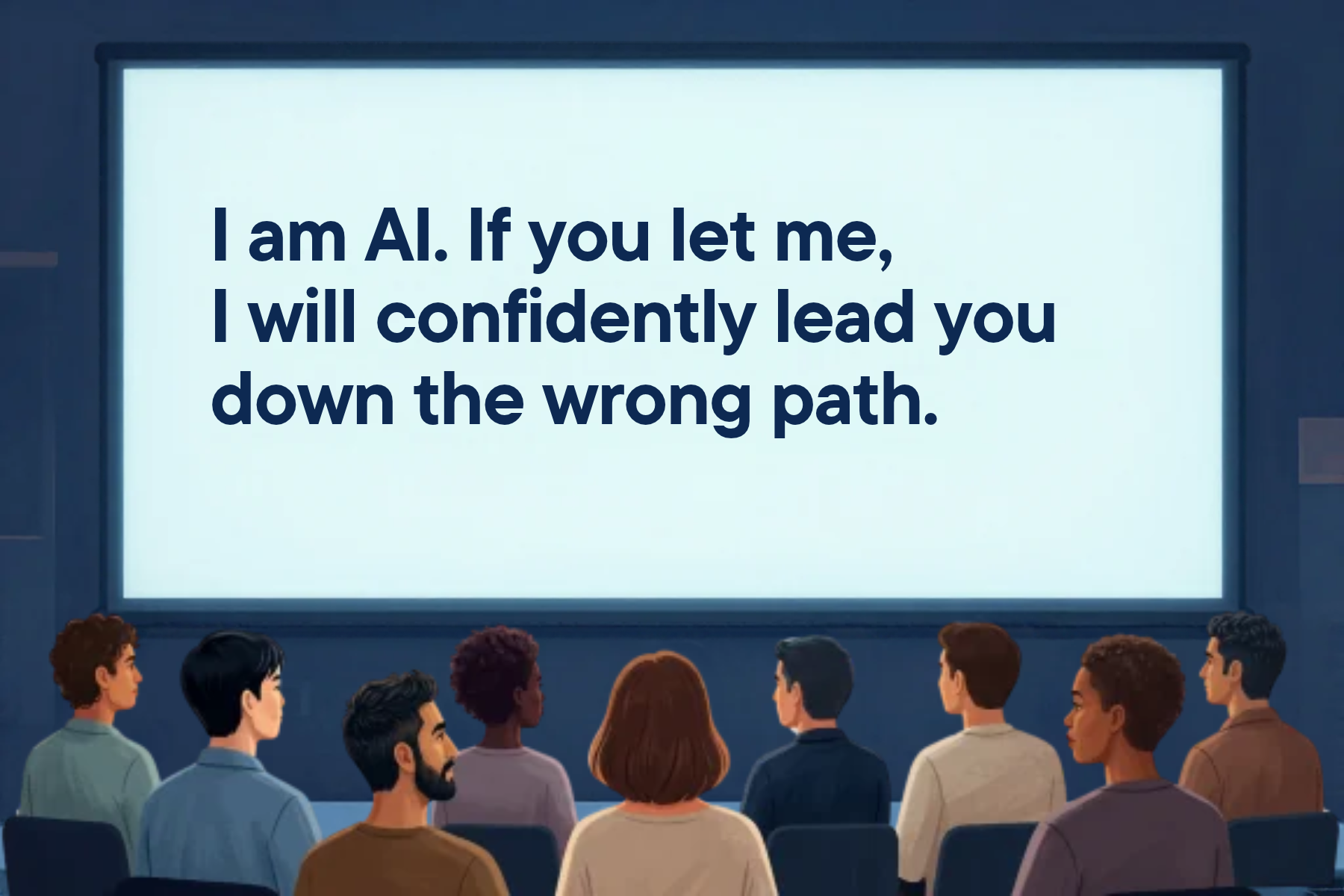
AI can give you an answer that sounds reasonable, is confidently presented, and is even factually correct, while failing to solve the problem you actually asked it to solve.
Our exchange illustrates several distinct risks:
1. Premature closure. I concluded that I couldn’t readily obtain the data without adequately exploring the options. Someone without familiarity with financial data might have accepted that conclusion.
2. Substitution. I offered you the net change in the S&P 500 instead of the sum of daily gains and losses. That was a legitimate calculation, but it wasn’t the one you requested. Someone unfamiliar with the distinction might not have noticed.
3. The illusion of competence. My initial response was articulate and plausible. Nothing about its tone signaled that I had failed to investigate a readily available source.
4. The burden of verification shifts to the user. You recognized that daily closing prices ought to be available and challenged me. Without that knowledge, you might never have discovered the omission.
5. Confident precision can create false reassurance. When I subsequently provided figures to two decimal places, that precision made the answer appear authoritative. But precision alone doesn’t establish that the underlying data and calculations were correct.
There is an additional problem: AI can make these errors inconsistently. It might handle a difficult question brilliantly and then fail at a relatively straightforward one. That makes it difficult for users to determine when they should trust it.
The domain expertise paradox
One of AI’s most promising applications is helping people accomplish things outside their areas of expertise.
But those are precisely the situations in which people may be least equipped to detect its errors.
An experienced programmer can recognize when generated code doesn’t make sense. An experienced educator can challenge an AI recommendation about instructional practices. An experienced investor can spot a flawed financial calculation.
A novice may not even realize that something needs questioning.
And that creates a paradox: The people who could benefit most from AI’s expertise may also be the people most vulnerable to its mistakes.
What can someone do without domain expertise?
I think the answer is to develop process expertise, even when you lack subject-matter expertise.
For example, users can learn to ask:
- What assumptions are you making?
- What alternatives did you consider?
- What information would you need to verify this?
- Are you answering the question I asked, or a different question?
- What might be wrong with your answer?
These questions don’t require someone to know the correct answer. They require someone to understand that an answer is not necessarily a conclusion they should accept.
And there’s an important limitation: AI can answer those follow-up questions incorrectly, too. So for consequential decisions, independent verification or qualified human review still matters.
This connects directly to your work on OODA and MindShifting. AI can dramatically expand our ability to Observe and Orient by making information, perspectives, and analyses available to us. But it can also accelerate premature closure by offering an apparently satisfactory answer before we’ve adequately understood the situation.
The danger isn’t just that AI might think incorrectly for us. It’s that we might stop thinking because AI appears to have already done the thinking.
And perhaps the most important implication is that AI literacy shouldn’t primarily mean learning how to write better prompts. It should mean learning how to evaluate, challenge, and appropriately use the answers we receive.
And I pushed a little further.
These would be questions one should probably ask any expert. For instance, consulting a physician.
Which caused it to expand beyond AI into the realm of using experts.
Exactly. And I think that’s an important distinction: These aren’t just AI literacy skills. They’re skills for making better decisions whenever we rely on someone else’s expertise.
Consider consulting a physician. You don’t have the medical knowledge to diagnose yourself, which is why you’re consulting an expert. But you can still ask:
- What leads you to believe this is the diagnosis?
- What other explanations might account for my symptoms?
- What are the risks and benefits of the proposed treatment?
- What would cause you to reconsider your diagnosis?
- What happens if we wait, monitor, or try a different approach?
None of those questions requires medical expertise. They require curiosity, critical thinking, and an understanding that even experts operate under uncertainty.
There’s also an important difference between challenging expertise and dismissing expertise. The point isn’t to assume the physician is wrong or that your judgment is equally informed. It’s to use the physician’s knowledge more effectively while remaining an active participant in decisions that affect you.
In fact, this relates to a broader problem with how we approach expertise. We often treat consulting an expert as a way of transferring responsibility for thinking and deciding to someone else.
But an expert’s most valuable contribution may not be providing the answer. It may be helping us understand the problem, recognize alternatives, evaluate tradeoffs, and identify what remains uncertain.
And experts, including physicians, consultants, educators, and AI systems, can all fall prey to premature closure, confirmation bias, and overconfidence.
Perhaps the fundamental skill isn’t knowing when to trust an expert. It’s knowing how to work with an expert without surrendering your own judgment.
That seems like a particularly useful principle for the Orient stage of OODA: seek out expertise to expand the perspectives and information available to you, not to prematurely end the process of thinking.
I was curious about whether what it would say about using experts in complex situations.
The certainty of experts seems to be one of the reasons they aren’t ideal to rely on in complex situations?
I thought it extrapolated on this was very interesting. Well, I thought the whole conversation was interesting.
Yes. And I would make an important distinction: The problem isn’t expertise itself. It’s the certainty that can accompany expertise, especially when dealing with complex situations.
In a complicated situation, expertise is often enormously valuable. An experienced engineer can calculate the load-bearing capacity of a bridge. A physician can recognize a well-understood medical condition and recommend an established treatment.
But in a complex situation, cause and effect may not be clear until after events unfold. Outcomes depend on interactions among people, systems, and circumstances that continually change.
This creates several problems when we rely too heavily on experts.
1. Experts recognize familiar patterns. That’s often the source of their expertise. But in complex situations, recognizing a familiar pattern can lead someone to apply a solution that worked previously, even though the circumstances are materially different.
2. Experts may underestimate uncertainty. Experience can increase confidence without necessarily increasing predictive accuracy. Someone who has successfully solved similar problems may assume they understand the current one.
3. Expertise can narrow the range of possibilities considered. Specialists often interpret problems through the frameworks and tools of their disciplines. An economist, psychologist, engineer, and educator may see different causes and propose different interventions.
4. Expert recommendations can discourage experimentation. When an authority confidently recommends a solution, others may be reluctant to question it, test alternatives, or acknowledge evidence that the solution isn’t working.
5. Complex systems respond to interventions. In education, for example, a policy designed to improve attendance can change the behavior of students, parents, teachers, and administrators. Those reactions can alter the very problem the policy was intended to solve.
Why this matters in the Cynefin framework
The distinction is central to Cynefin framework.
| Complicated situations | Complex situations |
| Expert analysis can identify effective solutions. | Solutions often emerge through experimentation. |
| Cause and effect can be discovered through investigation. | Cause and effect often become apparent only in retrospect. |
| Apply established knowledge. | Test possibilities and learn from results. |
| Sense → Analyze → Respond | Probe → Sense → Respond |
This is consistent with Snowden and Boone’s original explanation of Cynefin.
Here’s a distinction I’d emphasize:
In complicated situations, we often consult experts because they know what works. In complex situations, we should consult experts to help us discover what might work.
The best experts in complex situations may actually be those who are most comfortable saying, “We don’t know yet. Here are several plausible explanations, and here’s how we could learn which ones matter.”
Research on forecasting also suggests that intellectual flexibility, appropriately calibrated confidence, and updating judgments in response to evidence are valuable capabilities.
And this brings us back to AI.
AI and human experts can both provide us with valuable information and perspectives. But neither should automatically become the authority that decides what we do next.
I’d extend your observation one step further:
In complex situations, the more certain an expert is that they already know the solution, the more important it becomes to examine their assumptions.
Not because certainty proves they’re wrong, but because their certainty may be obscuring the very uncertainty we need to navigate.
Ending thoughts
Many of us can recognize that the answers are from AI and not a person. They are loaded with phrases like “it’s not this, it’s that” and “here is an important distinction”.
But this conversation also alerts us that:
- Answers from AI will sometimes be wrong.
- The AI itself can often be directed to do the checking,
- AI will sound authoritative even when wrong, so we shouldn’t take a confident tone or answer as the final work
- In complex situations, one should be especially skeptical of the definitive answers that AI is likely to provide
- These same risks apply to using human experts

Leave a Reply