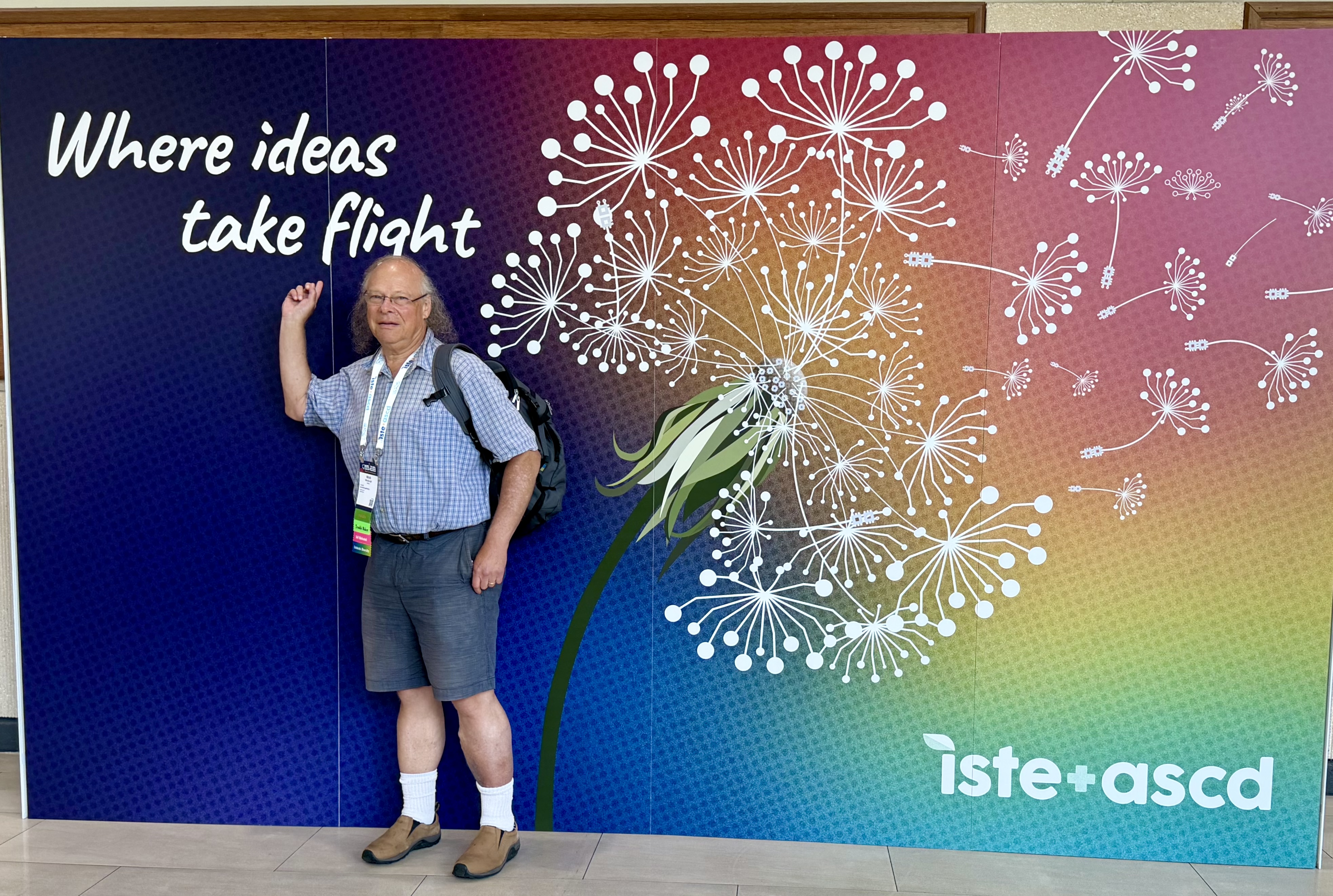
For those not familiar with it ISTE is the largest education conference in the US, with around 15,000 attendees. This year it took place in Orlando from June 28 to July 1. The exhibit floor had 30 rows of vendor booths. At any one time, there are 10-15 sessions running concurrently, mostly by educators plus vendor presentations.
The roots of ISTE are in education technology, although about two years ago they acquired or merged with ASCD which was a large content association with its own conference, and the two conferences now exist as one.
There were two things that stood out in this conference: 1) AI and 2) tech backlash.
AI in Education
Of the 600+ vendors and of the 300+ sessions, over 80% had something to do with AI.
Every product used AI to make students safer, help them read quicker, produce lesson plans with less effort, individualize content seamlessly, protect against cheating, make math fun, and so on. Nearly every session was about empowering students, saving time, producing engaging content, individualizing instruction, automating assessment, or stopping cheating using AI.
We are in the shiny new thing education economy; the inflated expectations phase of the Gartner hype cycle.
Those of us who have been attending ISTE over the last 20 years or so recognized the frenzy; we heard the same claims about interactive white boards, common core ready materials, revolutionary data analytics, individualized learning, and so many forgotten revolutionary innovations.
But AI really is qualitatively different. AI amplifies everything. However you want to teach or run your school, AI can allow you to do it faster. It researches faster, it produces faster, it grades faster, it individualizes faster.
As Tony Frontier noted in his AI with Intention session,
- Teachers can design and create their lessons with AI
- Students can have AI complete their work
- Teachers can grade the work with AI
- Schools and districts can evaluate teachers and students with AI
While everyone said, “AI will never replace the teacher, the teacher is the key to student learning” administrators and policy makers were licking their chops about how they could use AI to meet budget constraints (which is a polite way to say reduce headcount).
Will AI improve the way we prepare kids to become functioning adults?
Read on about the Tech Backlash and What About the Future.
The Tech Backlash
The trends for student learning are not good.
Since the introduction of the ubiquitous cell phone and then 1:1 computer devices in schools, all indications are the students are learning less and performing worse.
Reading and math results are down. Behavioral problems are up. Motivation in many cases is absent.
So let’s ban devices in schools and all these problems will go away. Simple.
Kids also eat too much junk food, so let’s ban food.
As anyone who has attended a MindShifting Course or read a MindShifting book knows, this is a limbic/survival reaction that treats a complex situation as a simple problem.
One point that Stacy Hawthorne, chair of the COSN Board of Directors and executive director of the EdTech Leaders Alliance pointed out,
Removing screens from schools just remove screens from part of their life, and it removes screens from the one place that students are safest. So, what a lot of people don’t understand, unless you’ve worked in K-12 education technology and know about all of the federal laws and state and local laws. When you give a student a school-issued device and you give them a school-issued account, that device and those accounts require filtering, monitoring, and student data privacy protections that are not required legally on a personal device.
So, putting a student on a personal device puts them at more risk than if they’re on a school-issued device. We’re not solving the attention problem by taking them away at school, because they’re still watching Instagram at home, they’re still on TikTok, they’re still watching TV, we’re just creating a cycle that makes it worse.
As Victor Rivero, Editor in Chief and Ed Tech Digest pointed out, there really are problems in education, there are tech problems in education, and there are tech problems with kids outside of education. We have to acknowledge that. Pro-tech and anti-tech both have to learn to communicate, explore what we have in common and our differences, and find ways to raise all boats.
Marci Goldberg adds that we also have to prepare kids to be nuanced. The Council of Foreign Relations, her client, is working to help students understand different perspectives so that we they know how to participate in cordial, respectful, productive civil discourse.
Maybe we all can learn to reject anyone advocating a simple solution to a complex situation, and if we find ourselves attracted to a simple solution as the answer to a problem, we can tap into our curiosity and spend time and effort examining what we are missing.
What About the Future?
The US education system was designed to measure student outputs. Grades are based on well-defined output. Today, there is virtually no student product that can’t be produced better and faster by AI.
Learning is a result of process. Processes are messy.
Leah Aiwahi tells the story of a group of seniors she taught this year.
I had a group of seniors who graduated this year, 2026 and their project work actually started last summer. So one of the students had started to notice, you know, in his church congregation there were a lot of elderly that were struggling in trying to learn technology, how to use a smartphone, and so he created a series of workshops to work with the elderly in his church to educate them, which kind of built on, you know, the discussions, it continued to build on the discussions they were having, and he, you know, started to incorporate more workshops to teach them about the pitfalls of technology, and what to look, you know, to look for, to be wary of.
Then they took what they learned teaching, and used vibe coding to create an app that seniors could use to detect whether a message or email was a scam. The app uses a screen shot and then AI to analyze the message against known or likely scams.
That’s the vision of what tech and AI could be.
In the example above, students used AI and tech as tools, but they themselves went through productive struggle. They were motivated, they engaged, they iterated, and they produced.
That’s not the experience of the vast majority of students, but it could be if we put our minds to it. We would need to change the entire role of school, moving from delivering content to developing capability, measuring compliance to documenting growth and impact, and covering standards to using standards for a purpose.
We’d need to overcome:
- Teachers (certainly not all teachers, but a good number) who resist changing the way they teach or who are already overwhelmed.
- School administrators who are rewarded for order, predictability, and avoiding trouble.
- District administrators who want scalable, defensible, measurable solutions.
- Vendors and tech companies because this threatens the platform and usage model.
- Politicians because they prefer reforms that can be announced quickly, photographed easily, and measured with a simple number.
- The professional blockers like lawyers, privacy officers, and insurance companies who find a potential liability in any activity that isn’t locked down.
Any ideas where we can start?



Leave a Reply