In Session 2 of MindShifting: Resilient Mindsets for Long-Term Success, we dove deeply into a distinction we often overlook but which affects how we lead, teach, and make decisions: the difference between complicated and complex situations.
At first glance, the difference can seem semantic. But as one participant reflected, “many situations, if we treat them as simple, they become complex fast and they snowball.” That shift—from expecting a single right answer to recognizing multiple possible paths—is foundational.
Complicated Situations
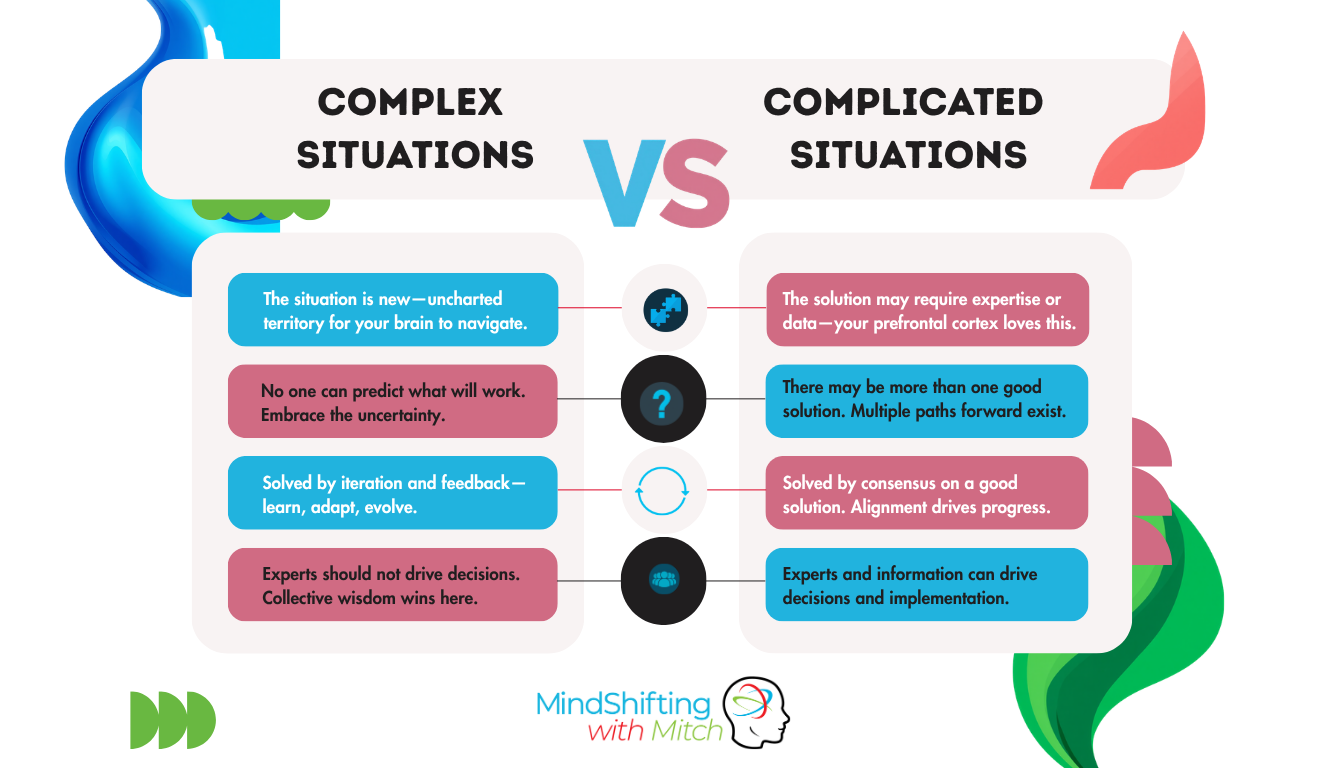
In complicated situations, expertise plays a central role. These are scenarios where “the answers…require a certain amount of expertise…[and] there’s likely going to be more than one path that’s going to be successful.” In other words, there isn’t always one perfect solution—but there are several good ones. Here, experts help us analyze options, avoid pitfalls, and choose a viable path forward. As was noted in the session, experts “can help you choose a solution more rapidly…avoid easily avoidable obstacles…[and] help with implementation.”
Decision-making in complicated contexts is about informed choice and alignment. It’s less about finding the answer and more about selecting a good answer and getting buy-in. In fact, “it’s not as important which one you pick as long as everyone can buy into it.”
Complex Situations
Complex situations, however, operate by entirely different rules.
In complex environments—like classrooms, organizations, or human relationships, “the solution cannot be determined in advance.” As one participant commented, “In a complex problem… you don’t even know where to start.” There is no amount of expertise or analysis that can guarantee success. Instead, outcomes emerge over time. The appropriate approach shifts from analysis to experimentation: try something, observe, adapt.
This is where many of our biggest mistakes occur.
Is it Complicated or is it Complex?
When we treat complex situations as if they were merely complicated, we assume there must be a definitive solution. We over-rely on authority, shut down alternative perspectives, and often default to blame when things don’t work. As was pointed out in the session, “when a person goes into a situation [thinking] that this is simple…they fall into a blame mode.” That shift not only limits learning—it actively reduces our capacity to respond effectively.
Even more concerning is the belief that once we’ve found a solution, it will continue to work. In complex systems, that assumption breaks down quickly. Conditions change. People adapt. What worked yesterday may not work tomorrow.
That’s why iteration is integral to resolving complex situations.
Why does this matter?
The deeper risk is cultural. When leaders assume there is only one right answer, people stop speaking up. As one participant shared, when decisions are made without listening, “it makes people really not want to speak at all…[and] creates a whole bunch of new problems.”
If you manage complex things as if they’re merely complicated, you’re going to set yourself up for failure because they’re two different entities. As one of the participants noted,
We treated a very complex situation as if it was complicated… and a year later we’re still going through it. Typical ways of analyzing… end up being counterproductive. Measurement becomes meaningless when the act of measuring changes what gets done. If you walk into a complex situation thinking that you’re going to come up with the perfect solution… you’ve already failed.
Session 2 challenged us to rethink not just how we solve problems, but what kind of problem we are actually facing. Because the moment we misidentify a complex situation as something with a single correct answer, we’ve already limited what’s possible.
The goal isn’t to abandon expertise—it’s to use it appropriately. To recognize when to analyze, and when to experiment. When to decide, and when to explore. And perhaps most importantly, to remain open to the idea that in complex situations, progress doesn’t come from having the right answer—but from being willing to keep discovering.

Leave a Reply