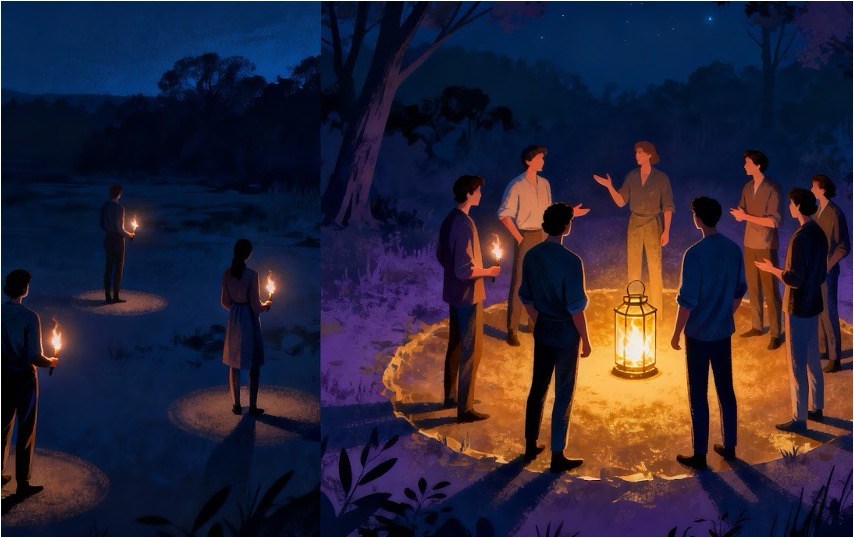
When we talk about collaboration—real collaboration, not the polite surface-level variety—we’re really talking about what happens inside the brain long before we ever sit down at a table with someone else.
Most people think that collaboration is most often derailed because of insurmountable differences in opinion. But in my work on MindShifting, and especially in Conflict and Collaboration, I have learned that the heart of the issue is simpler and far more biological: you simply cannot collaborate from a survival mindset.
If your brain interprets a situation as threatening, even subtly, you shift into a limbic mode that narrows your thinking, tightens your emotions, and locks down your ability to connect with others. Collaboration requires openness, curiosity, creativity, and long-term thinking—and those faculties live in a completely different neighborhood of the brain.
That’s why one of the central pillars of MindShifting is learning to shift from a limbic, fear-driven state into what I call the Sage mindset: a resourceful, grounded mode where higher-order thinking becomes possible again. When both people in a conversation access Sage, collaboration becomes not just easier—but inevitable.
Let’s walk through why this shift is so powerful, and how it fundamentally transforms our ability to work together.
The Brain in Fear Mode vs. the Brain in Sage Model
When we enter a limbic (or survival) mode, a very predictable neurological cascade occurs. The brain releases stress hormones—cortisol and adrenaline—and just like a dimmer switch, the prefrontal cortex goes offline. That’s the part responsible for planning, empathy, analysis, nuance, and innovation. In other words: everything collaboration depends on.
In that state, the brain defaults to one of the classic survival responses: fight, flight, freeze, fluency, or follow. These reactions are fast, rigid, and binary, because the brain is designed to protect us, not help us solve complex interpersonal problems.
This is why arguments so often escalate fast. Two limbic brains meet, mirror neurons fire, and fear amplifies fear. The conversation becomes limbic-to-limbic—a closed loop that only produces defensiveness, certainty, and escalation.
By contrast, when we shift into the Sage mindset, the brain releases what I call the DOSE hormones: Dopamine, Oxytocin, Serotonin, and Endorphins. These chemicals activate the prefrontal cortex and open the gateway to resourcefulness. The result is a feeling of groundedness, curiosity, and clarity—not because we’re “trying to be better,” but because the brain is operating from an entirely different circuitry.
This is the foundation of collaboration: two people with access to their best thinking, not their fastest fears.
The Five Sage Powers That Make Collaboration Possible
Once we move out of survival mode and into Sage, we gain access to what I describe as the five “superpowers” of the prefrontal cortex. These are not abstract ideals—they are specific mental capacities that dramatically reshape how people work with one another.
1. Empathy
This is the antidote to suffering in conflict. When we operate with genuine empathy—not the performative version—we stop trying to control the situation and start trying to understand it. Collaboration can’t thrive without appreciation, compassion, and the ability to forgive.
2. Exploration
Survival mode shuts curiosity down. Sage reopens it. Exploration gives us permission to ask questions without defending a position, and to look at a situation with wonder instead of worry. It’s how conversations move from justification to discovery.
3. Innovation
Innovation requires psychological safety, and that doesn’t exist in limbic mode. When we’re in Sage, we can break free of old assumptions and build new ideas together. This is where collaboration stops being a negotiation and becomes creation.
4. Navigation
This power aligns decisions with values and long-term consequences. In heated moments, most of us get swept into short-term wins (“I need to prove my point”). Sage helps us orient toward what truly matters.
5. Focused Action
Here, action becomes feedback—not a verdict on success or failure. Using the OODA Loop (Observe–Orient–Decide–Act), we can iterate, adjust, and keep moving. Collaboration becomes dynamic rather than brittle.
These powers aren’t just helpful; they are the required capabilities for any interaction where people hope to move forward together.
How the Sage Mindset Interrupts Conflict and Rebuilds Connection
One of the least understood aspects of conflict is that the limbic system only deals in binaries: right/wrong, win/lose, good/bad. That means the moment we slip into survival mode, the problem collapses into a false choice—and collaboration collapses with it. In survival mode, we are either avoiding, accommodating, or fighting.
The Sage mindset reintroduces nuance. It allows for the possibility that:
- multiple things can be true
- multiple solutions can exist
- the right answer may not be knowable yet
- the best path might emerge through interaction
This shift alone diffuses more conflict than most people realize.
Just as importantly, the Sage mindset enables what psychologists call noncomplementary behavior—responding to negativity not with matching negativity, but with empathy, curiosity, or calm. This interrupts the limbic-to-limbic loop and invites the other person back into resourcefulness. It’s one of the most powerful tools in the MindShifting repertoire.
When both people reach Sage, the collaborative conflict style becomes available: a mode where the goal isn’t to win the argument but to enlarge the solution space so everyone’s deeper needs are met. This is where trust grows. This is where innovation happens. This is where relationships move from strain to strength.
Collaboration Begins Before the Conversation Starts
At the heart of it: shifting to Sage is like clearing a cognitive traffic jam. Once the survival brain quiets, the pathway to the prefrontal cortex opens, and real collaboration finally has room to breathe.
From there, we move out of reactive cycles and into a learning loop—one that empowers us not just to resolve conflict, but to create something better together than either of us could have created alone.
Probably one of the best examples of this is the movie Spider-Man: No Way Home, which became one of the highest-grossing films of all time. Before 2019, Sony Pictures owned the film rights to Spider-Man, while Marvel Studios (Disney) owned the rest of the Cinematic Universe. Big studios competed, they didn’t collaborate.
In an unprecedented move for rival studios, they agreed to share the characters. Sony would keep the rights and distribute the films, but Marvel would take the creative lead. Both companies made more money, and the creative storytelling reached heights that neither studio could have managed in isolation.
That’s the promise of the Sage mindset. And it’s the foundation of every sustainable, resilient collaboration.

Leave a Reply