
“Certainty is not wisdom — it’s often a stress response.“
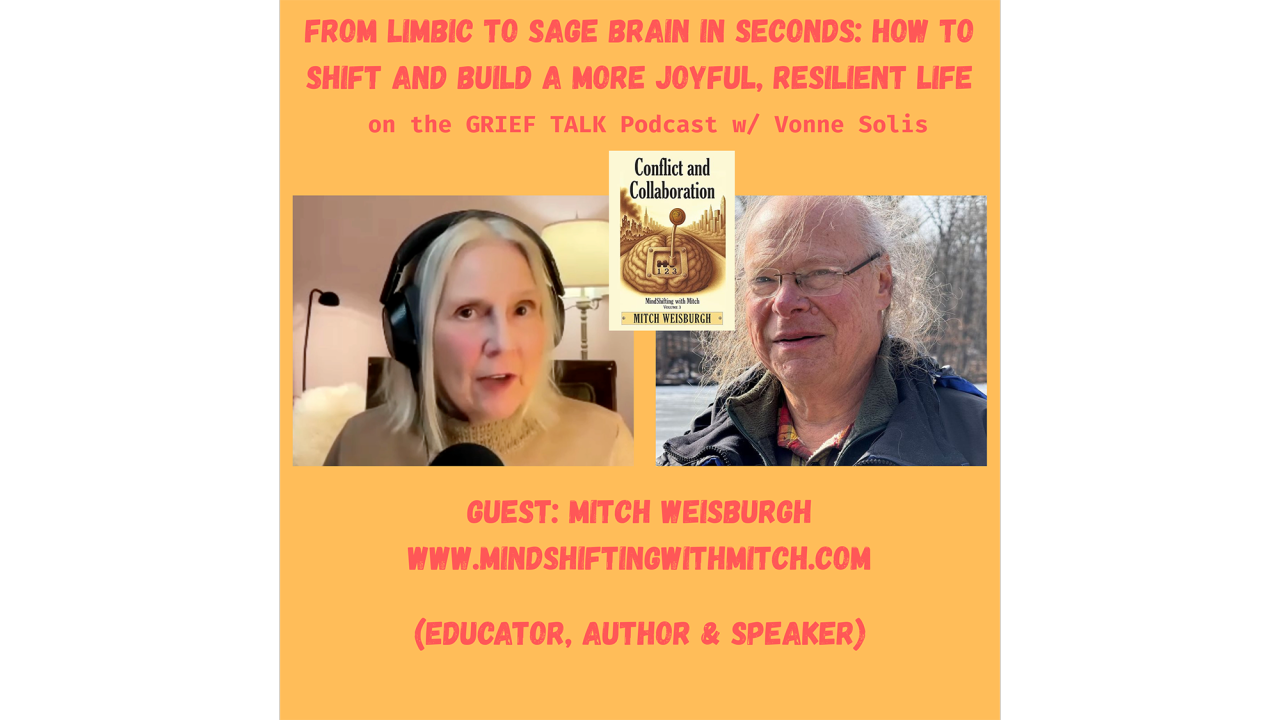
I hadn’t planned to say that on Grief Talk, but once it surfaced in conversation with Vonne Solis, i must admit that where it led us has stuck with me.
Vonne has a rare ability as a host to slow conversations down just enough for people to stop performing and start thinking. She draws her guests toward ideas they didn’t arrive intending to say, but somehow recognize as true once they’re spoken. That quality makes Grief Talk more than a podcast. It becomes a space where reflection actually happens.
That’s why I was honored to return for my second appearance on her podcast, and especially honored to be her first guest of 2026.
As we talked, that one sentence opened a broader conversation about grief, trauma, and chronic stress — and the ways they shape how the brain works, often long after a loss has occurred, and often in ways people don’t immediately recognize as grief.
Grief Is a Common Human Experience
Most people associate grief with the death of someone close. That kind of loss is profound and deserves care. At the same time, grief appears in many other moments of life. People grieve relationships that end, identities that shift, careers that stall or disappear, health that changes, and futures they once felt certain about.
Because grief is so widespread, it influences how people think, decide, and relate to one another far more often than we tend to acknowledge — including how we interact with others who are carrying loss quietly at work, at home, and in everyday conversations.
Understanding what grief does in the brain helps make sense of those interactions.
Grief and the Brain’s Survival Mode
Under stress or loss, the brain often shifts into a protection-focused state. This involves the limbic system, which prioritizes speed, pattern recognition, and threat detection.
In this mode, reactions come quickly. Familiar habits take over. Emotional intensity rises. The nervous system stays alert, scanning for what might go wrong next.
This shift helps explain why people experiencing ongoing grief or chronic stress often feel reactive, exhausted, or stuck in repetitive thought patterns. Mental energy is being directed toward staying safe rather than toward long-term planning, creativity, or perspective-taking.
Why Grief Narrows Thinking
One of the clearest signals that the survival system is running the show is certainty.
In the podcast conversation, we talked about how feeling completely sure — sure about motives, sure about blame, sure about what something means — frequently accompanies stress and grief. From the brain’s point of view, certainty simplifies the world. Simplification reduces cognitive load and supports faster decisions.
The prefrontal cortex supports curiosity, flexibility, and the ability to hold multiple perspectives. Under sustained stress, access to those capacities becomes less reliable.
This is why grief often shows up as rigid thinking, black-and-white conclusions, and internal stories that feel convincing and urgent.
Regulation Comes First
One of the most important ideas that emerged in the conversation is that regulation comes before reasoning.
When the nervous system is activated, logic and reassurance rarely land the way we expect them to. Reflection requires enough internal stability for the prefrontal cortex to participate again.
In our discussion, regulation didn’t appear as a formal technique. It showed up in small, human choices:
- pausing instead of responding immediately
- lowering emotional intensity rather than matching it
- noticing blame, urgency, or certainty as internal signals
- shifting from being right to being curious
These moments don’t remove grief or stress. They change the brain’s operating conditions just enough to restore choice.
Pausing at Certainty Restores Choice
If I had to highlight one regulation move from the conversation, it would be noticing certainty and pausing there.
When I catch myself thinking, “I know exactly what this means,” or “I know why they did that,” that’s my cue to stop. Not to fix anything. Not to reframe yet. Just to pause.
That pause interrupts automatic reactions and slows escalation. It creates space for alternative responses — curiosity instead of accusation, restraint instead of reaction, silence instead of defensiveness. Even a brief pause increases the likelihood that judgment improves and that the interaction unfolds differently.
The move itself is small. The effect is cumulative. Over time, it influences how conversations, decisions, and relationships evolve under stress.
Grief, Emotional Contagion, and Other People
Grief doesn’t live only inside individuals. Humans are wired with mirror neurons, which automatically pick up emotional cues from others. This capacity supports empathy, learning, and connection. Under stress, it also helps explain why emotional intensity spreads so quickly.
When someone carrying grief encounters criticism, impatience, or heightened emotion, their nervous system often mirrors that energy instantly. Escalation follows. Withdrawal happens. Misunderstandings deepen.
This dynamic plays out in families, workplaces, friendships, and public conversations. Many conflicts become easier to understand when viewed through the lens of stress and unresolved grief.
Going Deeper
The podcast embedded below explores additional dimensions of grief and the brain, including:
- how blame emerges under stress
- why grief heightens sensitivity to social exclusion
- how group dynamics amplify emotional responses
- practical ways to regain access to reflective thinking
The conversation offers nuance, lived experience, and examples that expand on what I’ve shared here.
A Shared Responsibility
Grief is part of being human. It shapes how we think, how we act, and how we relate to one another — often quietly, sometimes dramatically.
When we understand how grief affects the brain, we gain language for experiences that otherwise feel confusing or personal. That understanding creates room for patience, skill, and wiser choices — for ourselves and for the people we encounter every day.
Watch the entire conversation, below:

Leave a Reply