
A Journey into OODA Loops
Our brains really mess with our head.
We observe a situation and immediately know what to do. But then someone opposes us or gets in our way. Or someone else has a different idea. Or we try to do it, and it doesn’t succeed right away.
And then our survival instincts tell us it is safer just to give up.
Our limbic brains look for whom or what to blame. Bad luck. Our own ineptitude. Life. Idiots.
Well, the purpose of this article is to convince you to stop trying. You’re not going to succeed anyhow, you’re just going to get frustrated. Just focus on your phones; scroll, and find the crowd who want to gripe along with you. Post a screed or two at people who disagree. Maybe take an hour or two and scroll through meaningless mildly entertaining videos.
The Opposite of Blame and Giving Up
Or, if that doesn’t ring your bell, maybe learn a new concept and technique that will improve our ability to persist, adjust, and succeed.
That technique builds on the way our brains naturally solve problems when we are resourceful and resilient.
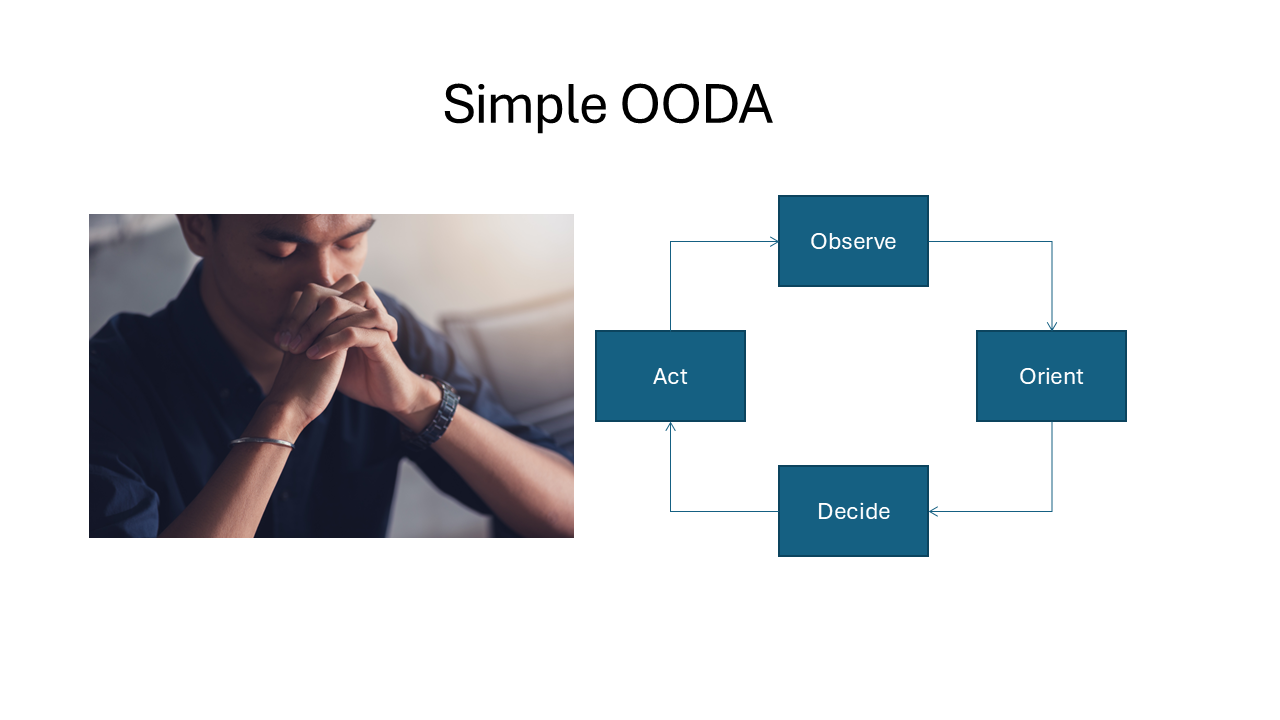
When we are curious, we first look at what is happening. We come up with some things we might be able to try and what we think might resul if we do try them. We decide on what we are going to do. We try it out. And then we use the results to go through the process all over again.
Four steps:
- Observe: look around, gather information.
- Orient: use that information, what you already know, to come up with possible actions and what you think might happen
- Decide: pick one or more actions to try
- Act: try one of the action with the purpose of getting information back instead of an expectation of success or failure
Four steps and then looping back through those four steps again.
What do People Say About Using OODA Loops
Here are some personal experiences of people we’ve trained in OODA loops:
- I went through an OODA loop for a student who frequently shuts down and needs a break in my class. I first observed the student’s behavior and also talked with them to figure out what might have been the cause of this behavior. It seemed to stem from difficult/challenging tasks that do not come easy to them. I then had to orient, both for me and the student, with my thinking having to go away from more negative views of why can’t this student just do this, to a place of curiosity and acceptance. As for the student, it was fairly similar, stating things like “that sounds hard, I get that” and “sometimes the really difficult things are the most rewarding to solve”. After this, I decided what would be best was more frequent check-ins with this student, as they seemed to benefit greatly from our conversation we were having, felt more grounded, and ready to take on the task. As such, I planned a check-in for tomorrow where we would see how he was doing, go and talk about anything difficult he found that made him upset, and then a brief walkthrough with me. – John Broer, Special Education teacher
- It’s the end of the semester and I have a lot of students and guardians who are upset about grades. Using the OODA method, I came up with a few options/possible solutions for students and their families to retrieve credit depending on the situation and possible reactions. I also came up with a few options to try when there are not necessarily positive outcomes, because not all parents or students approach issues with a positive or growth mindset in mind. – Kelsey Kosin, Teacher
- A student really wanted to stay during my break to work on a “passion project.” Observe: Listen to why he wants to stay and what he wants to do during break. Orient: I don’t always have time to supervise a student during break. Decide: He cannot stay during my break because I need the time where I am not supervising students. BUT… Act: Find a solution where the student can use class time/speed up the project for him. Iterate: Be prepared to be flexible to unanticipated obstacles. – Bri Covert, Teacher Juvenile Detention School
Learning More About OODA Loops and Iteration
MindShifting: Conflict and Collaboration has a good explanation on how to use OODA loops along with examples.
Here is a short video of Tammie Schrader explaining OODA loops in a MindShifting: Resilient Mindsets for Long-Term Success course.


Leave a Reply to Nick TurkCancel reply