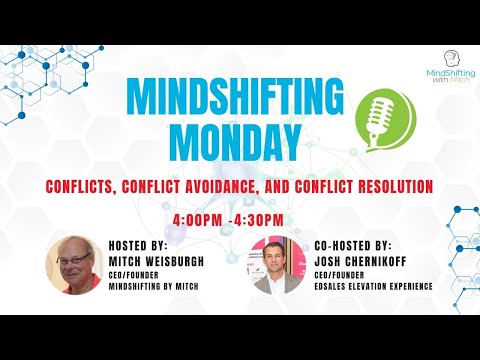
Every Monday, I go live on LinkedIn for Mindshifting Mondays with Mitch, a weekly series where I sit down with friends, colleagues, and thought partners to unpack how MindShifting applies to real-world challenges. In our third episode, I had the pleasure of welcoming back my good friend Josh Chernikoff, a seasoned entrepreneur and leader in the education and EdTech space.
Josh and I have known each other for years, and what I love about our conversations is how easily we can jump from daily business experiences to the deep neuroscience behind how people think, react, and relate. This episode centered around one of the most universal (and most misunderstood) topics in both business and life: conflict.
Our thesis, if I had to put it into a single line, was this: Conflict is inevitable, but escalation isn’t because when we understand what’s happening in our brains during moments of friction – whether in a sales call, a team meeting, or even a family disagreement – we gain the ability to shift from reaction to awareness and then from defense to dialogue.
Where Conflict Begins
Josh began by describing something I think almost everyone in a persuasion-based role, like sales or teaching, has experienced. You believe in your product or idea. You share it enthusiastically with someone, certain it will help them. But instead of leaning in, they push back. Maybe they say it’s too expensive, or maybe they just go silent.
If we have experienced that in the past, even the expectation of a conversation can lock in a conflict mindset. As Josh pointed out, the conflict often starts in our own heads. Our internal dialog goes, ‘They don’t get it.’ ‘ I must have failed.’ ‘Maybe I need to rebuild everything from scratch.’ And that internal dialogue can spiral fast.
From a MindShifting perspective, that’s what I call a self-generated conflict. It’s not even about the other person. It is about the conversation happening inside your own mind. You can’t win that kind of argument by reasoning or by force. The first step is self-awareness; recognizing that your fight-or-flight instincts have taken over. The second is to calm the body so the brain can think clearly again.
From Misalignment to Understanding
In business, we often mislabel misalignment as conflict. At the IEI conference Josh attended recently, he saw this dynamic play out between education companies and school administrators. The vendors were pitching features; the superintendents were describing needs. They weren’t actually in conflict but they were most certainly misaligned.
The key, I told Josh, is listening, listening with curiosity. We tend to listen solely for the opportunity to say what we wanted to, but the other person can tell if you are listening with an ulterior motive or if you are listening through curiosity and empathy. You don’t have to change your product to meet every concern, but you do have to listen deeply enough to understand the other person’s perspective and frame your solution in a way that connects to their priorities. This helps because listening reframes conflict as collaboration.
This ties directly into what I write about in my upcoming book (available in December) MindShifting: Conflict and Collaboration, the idea that every interpersonal tension is a signal to slow down, listen, and find shared ground.
What’s Happening in the Brain
When we sense resistance, our survival brain kicks in; those primitive neural systems that activate in a fraction of a second. They push us into one of three automatic responses: fight, flight, or freeze.
The challenge, as Josh and I discussed, is that these instincts also trigger the same reaction in others. If you push, they push back. If you withdraw, they disengage. If you freeze, they get frustrated. And through a concept called mirror neurons, our emotions literally bounce off one another.
This is why arguments spiral so quickly, with each person’s defensive reaction amplifying the other’s. But here’s the good news: mirror neurons also work in our favor. When we project calm, curiosity, and confidence, others unconsciously mirror that energy too. As I told Josh, “We can’t stop the initial surge of emotion—but we can recognize it and choose what happens next.”
We discussed a simple three-step process laid out in Conflict and Collaboration called the 30-Second Conflict De-escalator.
The steps are:
- Calm yourself (breathe, pause, lower your tone).
- Build rapport (find a shared goal or emotion).
- Gather information (ask questions that move you both toward understanding).
Once calm replaces urgency, collaboration becomes possible. As a MindShifting reader, you can download a cheat sheet for the 30-Second Conflict De-Escalator.

The Bottom Line
Conflict is part of being human. We can’t wish it away, outthink it, or pretend we’re above it. But escalation, which damages relationships, derails teams, and shuts down communication, is optional. When we stay self-aware, manage our reactions, and lead with curiosity instead of defensiveness, conflict becomes less about winning or losing and more about learning.
That’s what makes conversations like this one with Josh so valuable. He always brings a wealth of experience from entrepreneurship, sales, and education; as well and a thoughtful humility about what it means to lead and connect with others.
So, thank you,Josh, for joining me again and for helping bring these ideas to life through your stories and insights.
If you’d like to explore these ideas further, join me live every Monday at 4 PM EST for MindShifting Mondays with Mitch or catch the replay at 7 PM EST. Each week we dig into practical ways to shift your thinking, calm your brain, and build better relationships at work, at home, and everywhere in between.

Leave a Reply