
leadership is no longer about having all the answers. It’s about asking better questions. It’s about empowering your people. And it’s about fostering the kind of mindset that allows your team—and your entire organization—to adapt, grow, and lead in the face of constant change.
That’s exactly what the MindShifting framework was built for.
Originally developed to help individuals unlock their full potential, MindShifting has proven to be just as powerful in the corporate world—especially for leaders navigating the challenges of transformation, innovation, and talent development.
Let me show you how.
The Leadership Mindset That Moves the Needle
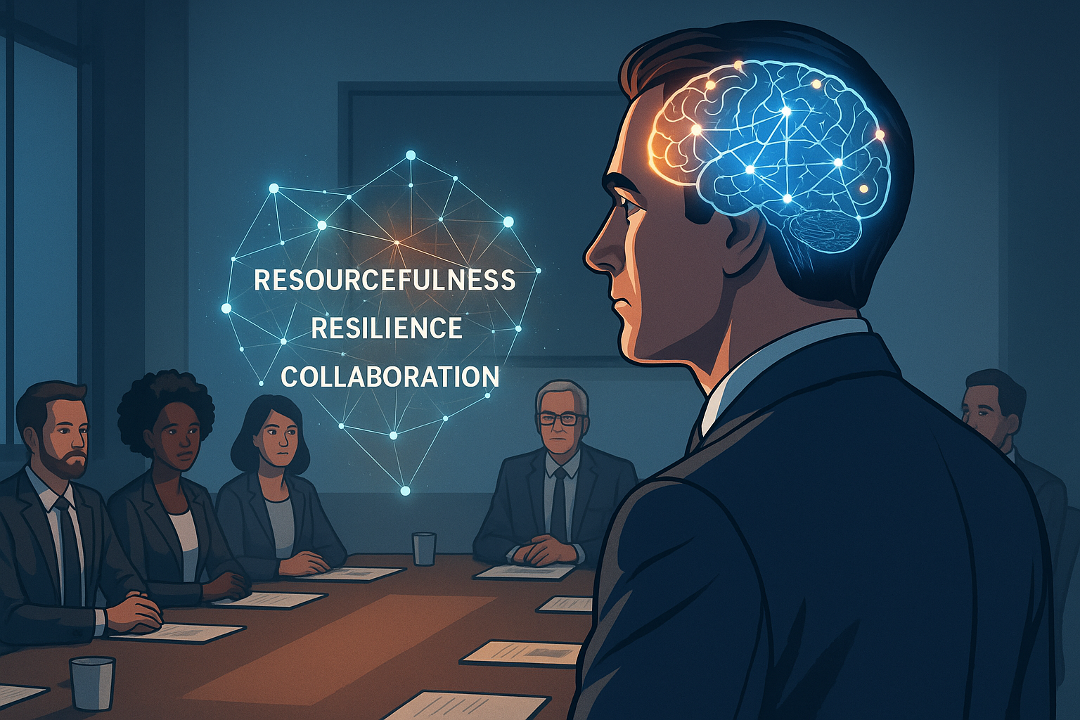
MindShifting revolves around three core principles:
- Resourcefulness: The ability to see problems from multiple angles, unlock hidden assets, and respond with creativity instead of panic.
- Resilience: The mental flexibility to view setbacks as feedback, learn from outcomes, and bounce forward with clarity.
- Collaboration: The skill to move progress forward through honest communication, conflict resolution, and shared accountability.
These aren’t soft skills. They’re survival skills in a world where disruption is the norm. And they’re the very traits that separate reactive managers from transformational leaders.
When you adopt this mindset as a leader, you create a cultural shift—one that fosters innovation, improves retention, and builds alignment around goals that matter.
MindShifting Starts with You
The first step? Apply the framework to your own leadership.
- Are you operating out of habit, or are you making conscious decisions based on evolving context?
- Do you treat resistance as a threat—or as a signal worth decoding?
- Can you model resilience not by always being “tough,” but by being transparent, adaptive, and willing to learn in public?
These are the kinds of self-reflective questions that leaders who MindShift ask themselves every day.
By internalizing the framework, you become the kind of leader others want to follow—because you don’t just demand performance; you model growth.
How It Transforms Teams
When leaders live and breathe the MindShifting mindset, the ripple effect is powerful:
- Teams become more adaptable because they’re empowered to think creatively without fear of failure.
- Collaboration improves because communication is grounded in shared purpose, not politics.
- Morale lifts because people feel seen, supported, and trusted to bring their full selves to the table.
You don’t need a formal workshop to make this happen. You just need consistency.
For example:
- In meetings, reward good questions, not just good results.
- During setbacks, model constructive interpretation, not blame.
- When tensions arise, practice and reinforce collaborative resolution, not avoidance.
Over time, your team will internalize the same behaviors you demonstrate.
From Culture to Strategy: Scaling the MindShift
The beauty of MindShifting is that it doesn’t just stay in the HR corner—it scales across the business.
- Product teams become more innovative because they iterate fearlessly.
- Sales teams become more agile because they listen and adjust rather than pushing rigid scripts.
- Operations teams solve problems more effectively because they trust one another and engage in solution-focused dialogue.
That’s when you move from a collection of departments to a true learning organization—one that adapts faster than the market and outperforms the competition over time.
Leading for the Long Game
MindShifting isn’t a band-aid or a pep talk. It’s a long-term play. A way to build an organization that thrives not just when things go right—but especially when they don’t.
Because let’s be honest: challenges aren’t going away. Supply chains will break. Technology will shift. Talent will ebb and flow. The difference between companies that stagnate and companies that soar comes down to mindset.
Are your people waiting for permission, or taking initiative?
Are they fearful of failure, or eager to learn from it?
Are they operating in silos, or building momentum together?
MindShifting gives you a leadership language to answer those questions with clarity and intention.
The Bottom Line: Great Leadership Is a MindShift
In the end, the most effective leaders are not the ones who control the most—they’re the ones who unlock the most. They create environments where resourcefulness is encouraged, resilience is rewarded, and collaboration is expected.
That’s what the MindShifting framework helps you do—not just as a theory, but as a daily leadership practice.
Because when you shift your mindset, you shift your team.
And when you shift your team, you shift your organization.
It starts with how you lead. It ends with how you grow.
To explore how you or your leadership team can integrate the MindShifting framework into your company’s culture and growth strategy, visit www.mindshiftingwithmitch.com.
—
About MindShifting with Mitch Weisburgh
MindShifting is transforming how individuals, teams, and organizations unlock their full potential—whether in the classroom, the boardroom, or personal growth journeys. Developed by educator, author, and thought leader Mitch Weisburgh, MindShifting combines the latest insights from psychology, neuroscience, and practical experience to help people overcome barriers, shift mindsets, and achieve lasting results.
Through his writing, keynote talks, and engaging workshops, Mitch empowers educators, corporate teams, and life coaches to embrace new ways of thinking and problem-solving. His unique MindShifting framework provides practical tools for building resilience, resourcefulness, and collaborative skills that drive real-world change.
To continue your exploration of MindShifting, visit www.mindshiftingwithmitch.com.

Leave a Reply