
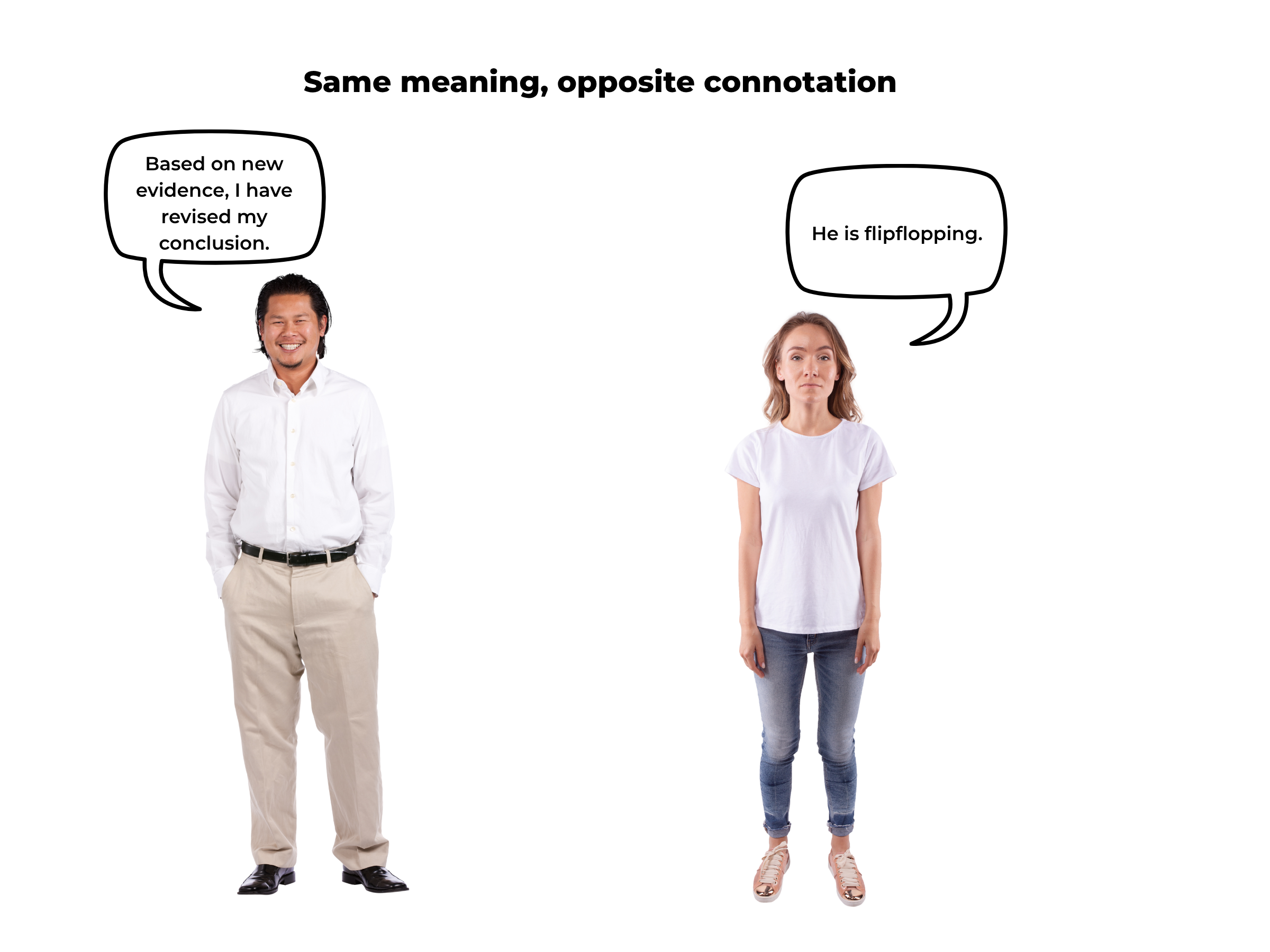
Bertrand Russel defined Russell Conjugations in 1948, showing how changing just one synonym can make sentences that were factually equivalent evoke strikingly different emotional reactions. Many words have a factual meaning and an emotional effect. Writers can change the entire meaning of a sentence by replacing a key word with a synonym that has the opposite connotation. For example:
- I am firm
- You are obstinate
- They are pigheaded
Most of us regard the first examples positively, the second one neutrally or slightly negatively, and strongly negatively on the third example. The same below:
- Based on new evidence, I have revised my conclusion.
- You changed your mind.
- They are flipflopping.
- He has gone back on his word.
It’s admirable for Alan Dershowitz to revise his conclusion based on new evidence. It may or may not be okay for him to change his mind. But for him to flip flop or go back on his word merely to support a paying client? Unforgivable! Definitionally, all four sentences are equivalent, but the reporter can attract and appeal to different audiences, evoking different responses by changing just a few words.
Many people support undocumented workers who are providing needed services while trying to provide for their family, but are against illegal aliens taking jobs and using resources that rightfully belong to Americans.
There are certainly a lot of things to be angry about right now.
Anger is one of our most central survival mechanisms. Anger and fear cause our minds to focus and our bodies to react. We are better able to ignore pain, filter everything else out except what we are angry at or afraid of, and focus on a binary action choice; we do this or we do that.
If a predator were to threaten us, we could flee or we could fight. That reaction has saved countless of our human, hominoid, hominid, mammalian, and vertebrate ancestors.
The anger/fear focus and action frame of mind, though, does severely limit other responses.
There is no creativity, no critical thinking, no innovation, and no room for other emotions when we are angry. We just have a binary choice.
How many of the problems we face can be solved with a quick fight or flight reaction?
Are we going to end racism or policy brutality by fighting? Are we going to build a just society where all kids have a chance to live meaningful lives through violence or anger? Are we going to reduce virus deaths through railing at those whose actions we disagree with?
Many of the situations that are feeding our anger are complex; they need creative options and then continuously improved reactions based on data and feedback. For some of these situations, we might do better to wait, think, and discuss. For others, we may need to provide safety first, and then once things are stabilized to enact longer term fixes.
If we are angry (or afraid) our minds are not capable of these solutions. In fact, we may end up “solving” the wrong problem because we lacked access to our creativity and critical thinking, and we only focused on that one aspect we were angry about rather than looking at the bigger picture.
Getting us angry is a tool used by demagogues. If we are angry, we only see two paths, strike out against the enemy they point out, or strike out against them.
We cannot counter a demagogue through anger, we can only win against a demagogue by learning to be resourceful through first calming our anger.
The first step to becoming resourceful is to recognize the anger and the second step is to choose to be resourceful as a more effective frame of mind than anger.
Sometimes, I say to myself, “Isn’t getting angry exactly what this other person wants? I control myself, it’s a good thing I know that I don’t have to be angry.”
Another technique I’ve used is to say, “What does this person who is provoking me to anger not want me to see, what are they hiding by trying to trigger anger?”
The first step to being effective is to understand anger for what it is.
- Anger is a survival mechanism that has existed all the way back into our reptilian ancestors, and possibly even earlier.
- Anger allows us to focus; it presents a do this or do that binary choice.
- Many of the situations we face are more complex, and require innovation, creativity, communicaton, deliberation, collaboration, and critical thinking. Those resources are not available to us when we are angry.
- Demagogues, back from our earliest history, have tried to trigger anger as a means of control.
- When our anger is triggered, we have the mechanisms in our own brains to replace anger with calm resourcefulness, which will be more effective in solving complex problems.
In 2022, former FBI Agent Kevin Clinesmith pleaded guilty to making a false statement, essentially admitting that he altered an email used to request permission to wiretap Carter Page to say that Page was “not a source” for the CIA. How do you explain that?
- Explanation 1: Law Enforcement constantly alters evidence in order to support their claims. This just happens to be a case where they were caught and a pawn was prosecuted.
- Explanation 2: Agent Clinesmith had a lapse in judgement, but basically did nothing misleading in that Page had supplied no information to the CIA even though he had been contacted about providing information.
- Explanation 3: The government bureaucracy was opposed to Trump and this was just one of the illegal methods they used to try to hamstring Trump and his administration.
- Explanation 4: FISA requests have been used by the government to spy on US citizens for forty years with no transparency and virtually no supervision; this example shows how corrupt they are.
The explanation you choose might say more about you than it does about the case.
These examples highlight the immense power of language, interpretation, and emotions, and how carefully chosen words can drastically alter perceptions. Understanding Russell Conjugations allows us to critically analyze the information we consume and to be more intentional in how we present our own ideas. How will you use this awareness to interpret and convey information more effectively in your daily life?

Leave a Reply