Practices That Help Leaders Access Better Judgment
A student puts their head down on the desk.
One teacher sees exhaustion. Another sees defiance. The behavior is identical, but the interpretation changes depending on the story already running in the adult’s mind.
The teacher who sees an exhausted child is using their judgment, experience, intuition, and common sense to reach a conclusion. But so is the teacher who sees a defiant rule-breaker.
That is one example of the challenge with cognitive bias in schools. It does not usually feel like bias. It feels like judgment, experience, intuition, or common sense. But when our brains rely too heavily on shortcuts, labels, group assumptions, or past experiences, we can miss what is actually happening in front of us.
Have you ever wondered why we sometimes ignore obvious facts, make the same repetitive mistakes, or lash out impulsively? Our senses send our brains 11 million bits of information per second: what we see, hear, feel, smell, or even taste. But our conscious minds can only process about 40 to 50 bits.
Our brains need shortcuts.
To cope and survive over millions of years, we’ve primitive limbic systems that rely on mental shortcuts, habits, and scripts (what neuroscientists call heuristics) to make lightning-fast decisions without conscious thought.
- Danger -> Run away
- Threat -> Fight
- Risk -> Stay with the herd
- Familiar -> Do what we’ve always done
While they save precious mental energy, heuristics frequently lead to systematic errors in our judgment known as cognitive biases.
In this post, we will explore a few specific cognitive biases that trip us up daily:
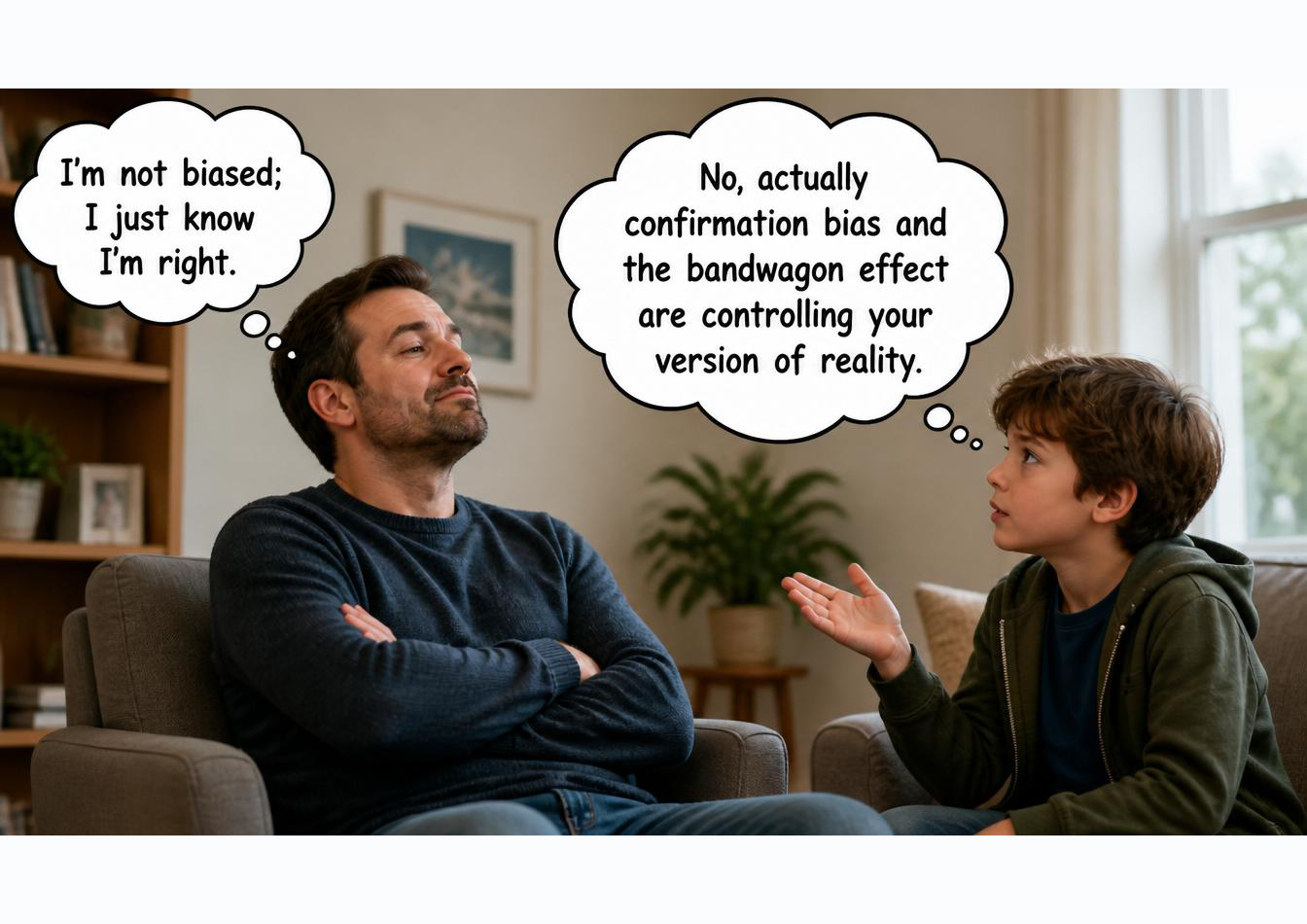
- Confirmation Bias: The deeply human tendency to actively ignore feedback or information that contradicts what we already believe to be true, while heavily weighting data that supports it.
- The Bandwagon Effect: The inclination to believe or do certain things simply because the rest of the group is doing so, taking the path of least mental resistance.
- Teacher Bias & Gifted Label Bias: Preconceived notions in education where a teacher interprets actions differently based on established feelings or labels assigned to a student.
- Affinity Bias: The illusion that we are objectively measuring competence or generating great ideas, when we are actually just naturally attracted to working with people who look and think exactly like us.
We recently talked about these cognitive biases in our MindShifting Practice Lab with participants who were discussing the MindShifting: Stop Your Brain from Sabotaging Your Happiness and Success book. Here is a look at how these biases show up in different areas of our lives, followed by the MindShifting methods we can use to overcome them.
Society: The Echo Chamber Effect In society, we are constantly influenced by confirmation bias and the bandwagon effect, which we experience daily in news consumption and social media. Algorithms are designed to find out what we (should) like and feed into it, ensuring we primarily see posts that support what we have already decided is true. We also self-select our sources and social circle which further confirm our worldview.
Sometimes, these cognitive biases amplify and strengthen each other. The bandwagon effect naturally draws us to join groups of like-minded individuals to feel safe and accepted. Once inside the group, confirmation bias takes over; the group actively shares and accepts only the information that validates their shared narrative, while aggressively discarding any dissenting viewpoints. When a person convinced of a media network’s bias sees a story that runs counter to their beliefs, their confirmation bias uses it as further “proof” of a conspiracy, filtering the facts to fit the group’s established story.
Personal Life: In my own life, I have definitely fallen victim to the limbic brain’s automatic reactions. For example, getting stuck in a traffic jam used to instantly trigger my frustration and anger. I felt like I had to react negatively because my inner “Saboteur” was telling me the situation was a disaster. When someone didn’t return my call, I was sure it was because I’d done something wrong.
School: Seeing Beyond the Labels Cognitive biases heavily impact education. For instance, consider that opening teacher bias instance where a student puts their head down on their desk during class. If the teacher is positively biased toward that student—perhaps viewing them as a high-achieving, hardworking kid—they might interpret the action as the student simply being exhausted from studying too hard and offer them grace. However, if the teacher is negatively biased toward a different student, they might interpret that exact same action as defiance, laziness, or disrespect. The action is identical, but the teacher’s script dictates a completely different response.
Consider a teacher facing a new policy. The immediate reaction might result in internal stories: that will never work, this is going to create more work for me, I’ve always done it this way and it’s worked just fine. Or it may result in opposite stories: what we’re doing isn’t working so we should try something different. I’m going to be a better teacher if I learn from this. The reaction is instant and unconscious from the teacher’s survival brain.
Work: Collaborating Over Controlling At work, affinity bias means we think that when everyone agrees, the group is being highly effective. Conversely, when someone objects to what we say, our limbic brain perceives it as a personal attack or a disruption. Actual data show that disagreement and discussion usually lead to more robust solutions; if we are feeling that everyone is in complete agreement, maybe that’s a sign we aren’t actively looking for problems or exploring diverse perspectives.
The Tools: How to Overcome Our Biases
We often recognize when others are biased, but fail to see it in ourselves. We would never judge two students differently because of our own biases even though we know others do. We would never fall prey to affinity bias; we are open minded. We would never categorically oppose a new policy without giving it a chance.
Fortunately, the tools for overcoming these traps are the same across all areas of our lives. The first and most critical step is metacognition, which is also referred to as self-awareness or the Interceptor. These are all different terms for the exact same thing: thinking about your thinking. It is the ability to recognize when you are locked into a negative script or limbic reaction.
Here is exactly how the Interceptor would play out in our previous examples:
- In Traffic (Personal): The Interceptor kicks in when you notice your heart racing and you realize, “Wait, I’m just reacting with my limbic Saboteur; the traffic isn’t intentionally attacking me. This is just a story I’m telling myself. What would be an enjoyable way to pass the time?”
- In School: A teacher using the Interceptor catches themselves right before disciplining the student with their head down, pausing to think, “Am I jumping to a negative conclusion because of my preconceived bias toward this child? What else might be going on?”.
- At Work: When a coworker objects to your idea, the Interceptor helps you pause and recognize, “I’m feeling defensive right now because they disrupted our agreement, but this disagreement might actually make our project stronger”.
In many cases, just becoming aware that your brain is reacting defensively is enough to dissipate the anger or fear and restore your resourcefulness. If awareness alone isn’t enough, we can use our “Self-Commander” mechanisms to calm down.
- Positive Self-Talk: We can consciously use constructive internal dialogue to open our minds. For example, instead of accepting the definitive story “I can’t do this,” we can shift our internal talk to a gentle, “Perhaps I can”.
- Redirecting Focus: Instead of dwelling on the stressor, we can redirect and focus our attention to something else, which gives our brain a chance to relax and flush out the stress hormones, which then gives us access to our resourcefulness. This could be practicing mindfulness, doing a quick meditation, taking a walk, or listening to music.
What about noticing biases in others? When we see friends, coworkers, or students locked in their own cognitive biases, we have to remember one crucial rule: we cannot make another person dispel their cognitive biases. You cannot MindShift for them.
Instead, we can only plant a seed. We can act as a “co-regulator” using an indirect, curious approach.
For schools, this matters because culture is shaped by thousands of small interpretations. Is that parent difficult or afraid? Is that teacher resistant or overwhelmed? Is that student defiant or dysregulated? Is that disagreement a threat or useful information?
MindShifting begins when we pause long enough to ask: What story is my brain filling in, and what else might be true? If we are implementing school or district initiatives, and we are aware that those affected will have immediate and unconscious reactions, perhaps we can frame our communications to help them build positive stories.
If you want to dive deeper into how to accomplish this, specific tools for co-regulating others are detailed in the books MindShifting: Stop Your Brain from Sabotaging Your Happiness and Success and MindShifting: Conflict and Collaboration.

Leave a Reply