We like to think of ourselves as independent thinkers, but much of what we believe, say, and do is powerfully shaped by the groups we belong to. That’s not a character flaw; it’s biology. We are literally wired to belong.
That was the topic of the April 27 MindShifting Monday with Mitch.
From an evolutionary standpoint, isolation was dangerous. The antelopes separated from the herd were the ones the lions caught. Over thousands of generations, humans developed brains that reward us for staying close to our tribe. When we connect with others, our brains release oxytocin, a hormone that generates feelings of warmth, safety, and trust. That cozy feeling you get at a family holiday or a great team meeting isn’t just emotional—it’s chemical reinforcement for belonging.
Another key part of this wiring is mirror neurons. These brain cells fire not only when we act, but when we see others act. They nudge us to imitate the people around us: if someone yawns, we want to yawn; if people in our group get excited about something, we start wanting it too. This is great for cooperation and coordination, but it also means we unconsciously copy negative behaviors—like anger, contempt, or bullying—without deliberate intent. The biology of imitation keeps groups together, even when the group’s behavior is unhealthy.
Belonging also runs through our pleasure and pain centers. Functional MRI studies show that when we’re rejected, criticized, or ostracized by a group, the brain regions that process physical pain light up; especially the anterior cingulate cortex and the amygdala. In other words, social exclusion doesn’t just feel bad metaphorically; it hurts in the same neural circuits as a physical injury.
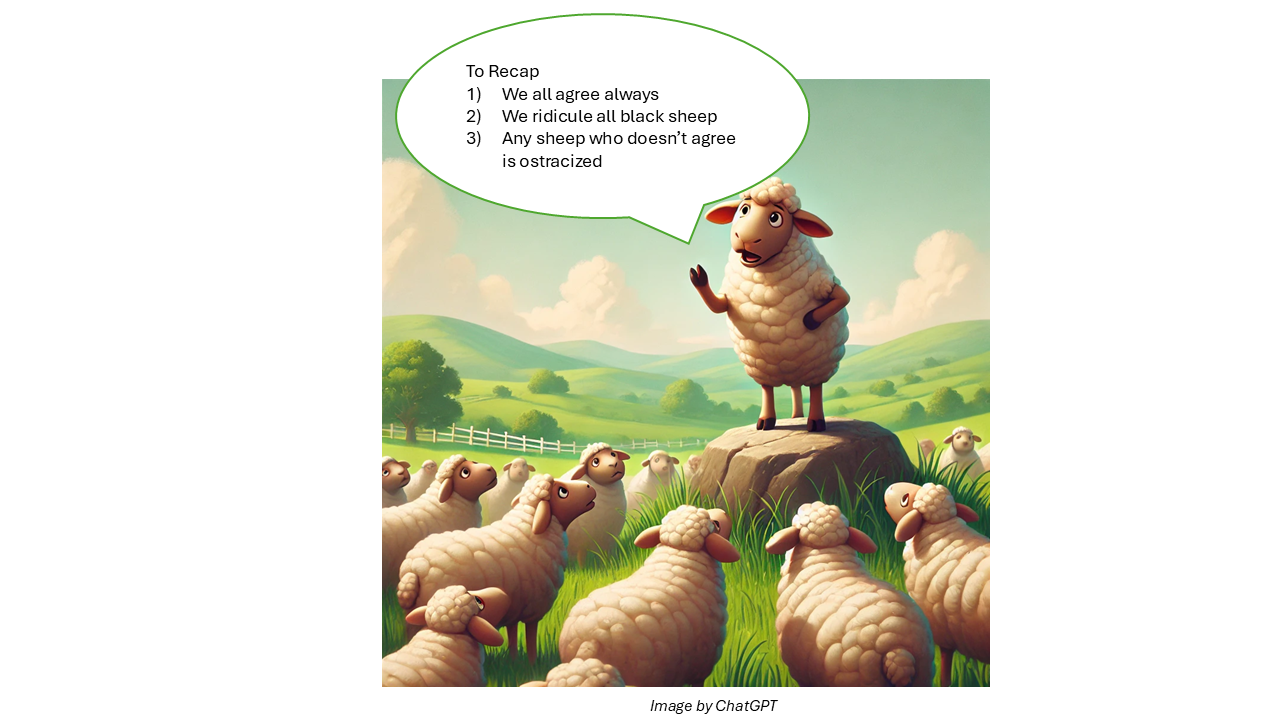
Because of this, going against our group—challenging its norms, speaking an unpopular truth, or expressing nuanced views in a binary, “us vs. them” environment—carries a hidden biological cost. Disagreeing with the group can activate pain circuits; agreeing with the group, even when we privately disagree, often activates reward circuits. Over time, this pushes us to self-censor, stay quiet, and sometimes even go against our own values just to avoid the “pain” of disapproval.
That’s how we slide into what researchers call collective illusions: situations where many people privately disagree with the apparent group norm, but nobody speaks up. Everyone looks around, assumes “I must be the only one who thinks this,” and conforms. The result? Whole groups doing what almost no one individually wants.
The good news is that awareness and intentional practice can weaken this automatic grip.
- The free downloadable Conversation Circle Guide, “When the Room Changes Your Mind,” is designed to help you explore these dynamics with your team, family, or community. A simple 45–60 minute guided discussion can surface how group pressure shows up in your world and how to respond more consciously. (Use the shared QR code or link to download it free and lead your own circle.)
- The upcoming Master Class on the three biggest mistakes districts make when trying to improve student outcomes (May 13 at 11:00AM Eastern time) goes deeper into how systems—like schools and districts—can “outlearn” their obstacles, including unhelpful group dynamics. (Use the registration QR code or link to sign up.)
When we understand the biology of belonging, we stop shaming ourselves and others for “going along,” and instead build structuresthat make it easier for people to think clearly, speak honestly, and still feel safe inside their groups.
That’s the goal of MindShifting and why we are offering free resources, like conversation circles and master classes.

Leave a Reply