
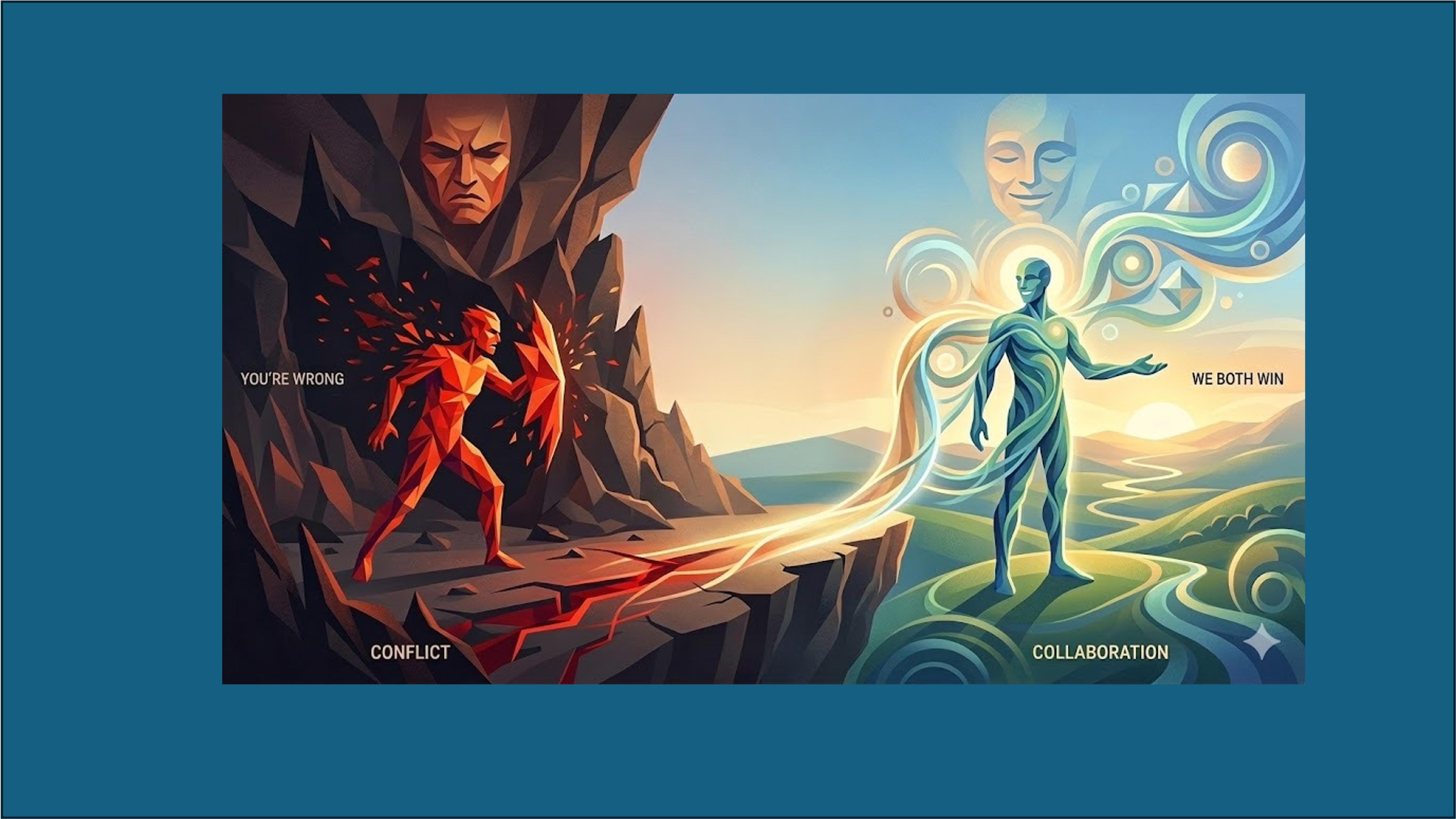
Most conflicts start with a simple, silent judgment: “You’re wrong.”
Once that sentence lands in your mind, the rest tends to follow.
You brace. You argue. You marshal evidence.
Your goal shifts from solving a problem to proving a point. The conflict becomes a battle: one of us is going to win, and it had better be me.
Mindshifting offers a different path. Instead of treating conflict as a fight to be won, it treats it as an opportunity to move from survival mode—where your limbic “fight or flight” brain is in charge—to Sage mode, where curiosity, empathy, and focused action make collaboration possible.
Two simple sequences anchor this shift: exploration with empathy and focused action with empathy.
Step One: Change the Story of the Conflict
When your limbic brain registers conflict, the story sounds like this: “We’re on opposite sides. If you get what you want, I lose.” That story creates win/lose dynamics at work, at home, and everywhere in between.
The Sage story sounds different: “We see things differently, but we’re both trying to meet important needs. If we understand those needs, we can look for a way for both of us to win.” That doesn’t mean everyone gets everything. It means we stop treating the other person as the enemy and start treating them as a partner in problem-solving.
To change the story, you first have to notice your own “you’re wrong” moment. That’s your cue to stop arguing in your head and move into exploration.
Here are two ways of constructively managing these moments, Exploration + Empathy and Focused Action + Empathy
Exploration + Empathy: Turn Battles into Joint Curiosity
The exploration→empathy sequence is all about slowing down enough to understand what’s really going on before you try to fix anything.
It has four moves:
- Connect. Start by lowering the emotional temperature and signaling that the relationship matters more than the argument.
- Ask open-ended questions. Draw out their view instead of jumping in with yours.
- Reflect back what you hear. Show that you’re listening and not just waiting to talk.
- Name the shared “why.” Look for what you’re both trying to protect or achieve.
Workplace example: manager vs. team member
Imagine a manager frustrated that a project is behind. The limbic script sounds like: “You’re not taking this seriously. You’re wrong. I need to push harder.” The Sage script looks different.
- Connect:
“I really value the work you do on this team, and I want us to tackle this project in a way that works for both of us.” - Explore (questions):
“Can you walk me through how you’re seeing this deadline?”
“What’s been getting in the way?” - Reflect:
“So you’re juggling two major priorities, and you’re worried that if you focus on this, the other one will fall apart. Did I get that right?” - Shared why:
“We both care about delivering good work and not burning you out. Let’s see if we can design a plan that protects both.”
Notice what’s missing: there’s no “You’re wrong.” The manager is not surrendering standards; they’re creating the conditions where collaboration is even possible.
Family example: parent vs. teenager
A teenager pushes against some limit. A parent might start in limbic mode: “You’re being disrespectful. You’re wrong. Hand over your phone.” The Sage version uses exploration and empathy first.
- Connect:
“You matter to me more than this argument, and I want to understand what’s going on.” - Explore:
“What’s this situation like from your point of view?”
“What are you trying to protect or accomplish here?” - Reflect:
“You feel like I don’t trust you, and you’re afraid you’ll lose all your freedom. That’s really scary for you.” - Shared why:
“We both care about your independence and your safety. Let’s see if we can come up with something that respects both.”
That doesn’t magically solve everything. But it shifts you from control to connection, which is where real collaboration begins.
Focused Action + Empathy: Move Forward Without Steamrolling
Exploration without movement can turn into endless talking. That’s where focused action with empathy comes in. Once you’ve connected and understood each other’s needs, you can move toward concrete requests and next steps—without slipping back into “my way or the highway.”
This sequence also has four moves:
- Describe the situation and behavior. Stick to observable facts, not judgments.
- Name feelings and needs—for both sides. Acknowledge the emotional reality.
- State what you’re asking for. Make a clear, specific request.
- Check for fit and adjust. Invite the other person to react and refine.
Workplace example: colleague who keeps interrupting
Limbic mode says, “You’re rude. You’re wrong. I have to shut you down.” Sage mode uses focused action with empathy.
- Situation/behavior:
“In the last two meetings, when I’ve started to explain my point, you’ve jumped in before I finish.” - Feelings/needs:
“I feel frustrated and a bit dismissed, because I need to know my perspective is being heard.” - Request:
“In our next meeting, could we agree to let each person finish their thought before responding?” - Check:
“How does that sound to you? Is there another way we can make sure both of us feel heard?”
You’re not attacking their character. You’re inviting them into a joint standard you can both live with.
Family example: partner not following through
Instead of “You never help—You’re wrong—I’m right,” try:
- Situation/behavior:
“We agreed last week that you’d handle the dishes three nights, and this week I’ve ended up doing them every night.” - Feelings/needs:
“I’m feeling exhausted and a bit taken for granted. I need to feel like we’re sharing the load.” - Request:
“Could we renegotiate who does what this week so it feels fair to both of us?” - Check:
“What would work for you so this is realistic?”
You’re still naming the problem clearly. The difference is that empathy is built in—for you and for them—so the conversation stays about the situation, not about who’s the villain.
Practicing the Shift: From “You’re Wrong” to “We Both Win”
In both these methods, the four statements open up a conversation. Thinking you can just follow the four steps is a little simplistic; it’s more likely to be a loop. You’ll go through the four statements, the other party will not fully embrace a common solution, and you’ll go through similar questions and statements.
You don’t need a perfect script to use this playbook. You need one habit: catching the moment when “You’re wrong” appears in your mind. That’s your signal that your survival brain is in charge and that you’re about to slide into a win–lose story.
When you notice it, pause. Ask yourself:
- “What might they be trying to protect?”
- “What do we both care about here?”
- “What would this sound like if I started from empathy and curiosity?”
Then choose one of the two sequences:
- If you don’t yet understand them, start with exploration + empathy.
- If you already have some shared understanding, move to focused action + empathy.
Over time, this becomes its own reflex. Instead of defaulting to “You’re wrong,” your brain starts reaching for “We both have real needs here—how do we both win?”
That’s the heart of Mindshifting in conflict: not avoiding tension, but transforming it into a space where better ideas, stronger relationships, and genuinely shared victories can emerge.

Leave a Reply