About this two-part series
This is Part 1 of a two-part series on Nonviolent Communication (NVC) and Motivational Interviewing (MI).
- Part 1 explains what NVC is, why it’s useful, and dives into the four core components with examples and judgmental→NVC rephrasings.
- Part 2 will show a 10-step interaction flow that combines NVC and MI, plus how to use AI to draft language and plan tough conversations in advance.
What is Nonviolent Communication?
Nonviolent Communication (NVC) is a communication framework developed by psychologist Marshall Rosenberg in the 1960s and 70s. Working in schools, communities, and conflict zones, he noticed that the way people talked about problems often made them worse. NVC emerged as a practical method to reduce blame and escalation and increase clarity, empathy, and collaboration.
NVC is used to:
- De‑escalate conflict
- Improve relationships (at school, at home, at work)
- Help people express needs clearly without blame
- Increase the chances that others can actually hear and respond constructively
At its core, NVC replaces judgment and “you always / you never” language with:
- Clear description of what happened
- Honest feelings
- Human needs
- Concrete, actionable requests
The Four Parts of NVC
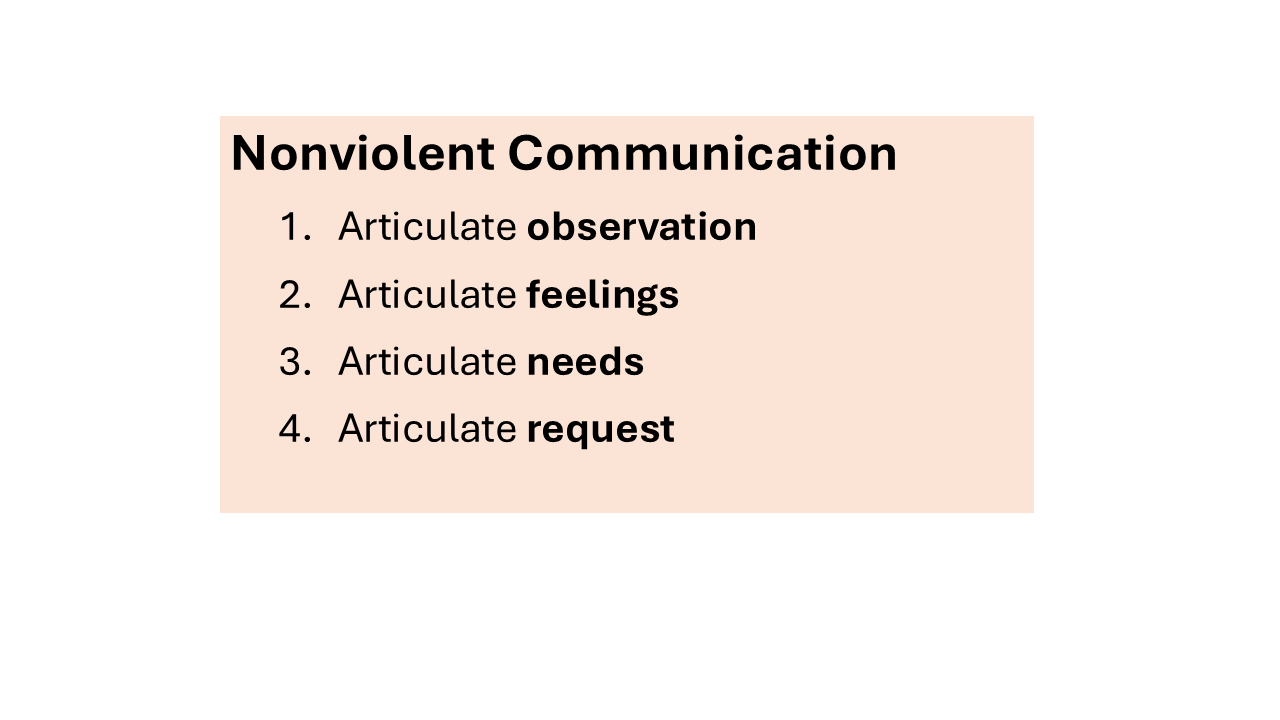
NVC organizes a message into four parts:
- Observation – What happened, in neutral, non‑judgmental terms
- Feeling – How you feel about it
- Need – What underlying need or value is involved
- Request – What specific, doable action you’re asking for
Example
Instead of:
- “You’re so lazy. You never turn anything in on time.”
NVC version:
- Observation: “For the last three assignments, your work has come in after the deadline.”
- Feeling: “I feel concerned and a bit stressed…”
- Need: “…because I need to be able to give timely feedback and support your progress.”
- Request: “Would you be willing to sit down with me today to plan how you can get the next assignment in on time?”
Same situation, but now it’s about behavior, impact, and needs, not about the student’s character.
Let’s take a deep dive into each of the four statements with some examples of judgmental statements and how one might turn them around.
Deep Dive: The Four NVC Components with Rephrasings
1. Observation
Goal: Describe what happened without evaluation or labels.
Judgmental:
- “You’re disrespectful in class.”
- “He’s a terrible teacher.”
- “You’re always unprepared.”
NVC-style observations:
- “Today during discussion, you spoke while others were talking and used a sarcastic tone.”
- “In your last three lessons, several students were talking over you and many were off task.”
- “This week, you’ve arrived without your tablet charged on three out of four days.”
Rule of thumb: If a video camera couldn’t capture it, it’s probably a judgment, not an observation.
2. Feeling
Goal: Own your emotional response without blaming the other person for causing it.
Blaming / fused feeling:
- “You make me so angry when you do that.”
- “You’re stressing me out.”
- “You’re ruining my day.”
NVC feeling statements:
- “When that happens, I feel angry and tense.”
- “I feel overwhelmed when I realize grades are delayed.”
- “I feel discouraged and tired hearing when I hear so many negative comments.”
“You make me” gives power to the other person, it gives them control over how we feel. They may say something and we may become angry, but they did not make us angry. “You’re ruining my day” gives up our own ownership of our feelings.
In NVC, we drop “you make me…” and simply say “I feel…”, letting the other person infer the connection.
In English we also sometimes use the word “feel” as a synonym for “in my opinion.” If I were to say, “I feel you are unreasonable,” I am judging someone and stating an opinion. It is not an NVC feeling statement, unless it’s my wife saying that about me. In that case it’s observation, feeling, need, and request all rolled into one and I know I have to change.
3. Need
Goal: Connect feelings to universal human needs or values, not to blame or moral judgment.
Judgmental / pseudo‑needs:
- “I need you to stop being so lazy.”
- “I need you to just care, like your brother did.”
- “I need you to respect me.”
NVC needs:
- “I need reliability so I can plan feedback times.”
- “I need to know you’re getting a real chance to learn this material.”
- “I need mutual respect so everyone can feel safe speaking in this class.”
The need statement has to be a positive statement or action, not that a person not do something. “I need you to tell me what you want to happen,” is a positive action, while “I need you to stop complaining,” is a negative statement and would not actually convey what you need, just what you don’t want.
We shift from labeling the person to naming what matters: reliability, learning, safety, fairness, etc.
4. Request
Goal: Ask for a specific, doable, positive action (not just what you don’t want).
Vague / demanding:
- “You need to get your act together.”
- “Stop being so disruptive.”
- “Don’t be late anymore.”
NVC requests:
- “Would you be willing to start the next assignment in class today and show me your first two answers before you leave?”
- “Next time you disagree, would you be willing to raise your hand and wait to be called on rather than talking over classmates?”
- “If you think you’ll be late, would you text the office at least 10 minutes beforehand?”
Requests are:
- Concrete (someone could see whether it happened)
- Framed as a request, not a threat
- Open to further discussion (the other person can say yes/no/counter‑offer)
In Part 2, we’ll put this all together in a 10‑step interaction flow that blends NVC with Motivational Interviewing, and we’ll look at how AI can help you draft language and plan those conversations in advance.
Nonviolent Communication is one of several powerful tools that can turn tense moments into opportunities for connection and growth. This article is adapted from MindShifting: Conflict and Collaboration, which dives deeper into Motivational Interviewing, Nonviolent Communication, and other practical techniques that help educators and leaders transform conflicts—or potential conflicts—into opportunities for learning and progress.

Leave a Reply