In Session 2 of the MindShifting: Conflict and Collaboration Course, we explored the role of mirror neurons in conflicts, conflict escalation, and conflict resolution. This is also examined in depth in Chapter 2 of the book.
One of the most fascinating—and often overlooked—drivers of our behavior in social situations is the mirror neuron system.
Mirror neurons are brain cells that fire when we observe someone else performing an action or speaking.
Our own mirror neurons activate in response to others’ behaviors, allowing us to unconsciously absorb and reflect the emotional states and actions of those around us.
Other people’s mirror neurons activate in response to what we do or say, allowing them to absorb what we are doing, motivating them to mirror or copy what they observe.
In short, when humans are around people who are happy, curious, or resourceful, they tend to mimic or mirror that.
When humans are around people who are angry, anxious, sad, judgmental, we tend to mimic that as well.
Sage or Limbic?
Before exploring how awareness can help us override these impulses, it’s important to define what we mean by a “Sage perspective.” The Sage perspective refers to a state of mind where we are resourceful, empathetic, curious, and open. When we are in Sage, our prefrontal cortex is engaged, allowing us to access higher-order thinking, creativity, and compassion. We are able to step outside of automatic, defensive reactions and instead respond thoughtfully, aligning our actions with our values and long-term goals.
In contrast, limbic reactions arise from the brain’s limbic system, which is responsible for our most primal, automatic responses to perceived threats. The limbic system operates almost 100 times faster than the prefrontal cortex, enabling us to react instantly but often without reflection or nuance. When triggered, we default to one of five types of limbic reactions: fight, flight, freeze, habit (automatic, learned responses), or following (aligning with or mimicking others to avoid conflict or gain safety). These reactions are designed for survival, but in modern social interactions, they can escalate conflict and prevent meaningful connection or problem-solving.
Mirror Neurons Driving Our and Others’ Reactions
Jane Lyons captured the dynamic of mirror neurons during our recent MindShifting class:
“All humans naturally mimic or mirror those emotions and actions of those around them. So if we are around people who are acting from their sage brain and are being in their creative, feeling successful and resilient, then we tend to mimic and mirror that. When people who are already inclined to be that way, see us acting that way, there’s a feedback loop and it escalates those traits for us. The same can be said of negative feelings. We want to mimic what we are around.”
This feedback loop is why a single person’s anxiety can ripple through a group, or why a calm presence can de-escalate a tense situation.
As you can see, mirror neurons are a double-edged sword. They can just as easily propagate anger, fear, or defensiveness as they can spread calm and cooperation. When we are triggered—when our limbic system perceives a threat, even a minor one—our mirror neurons can lock us into a cycle of escalating conflict, each person reflecting the other’s defensiveness or aggression.
But there is a way out. Awareness of our own internal state is the critical first step. As Tammie Schrader, a scientist and educator, explained:
“One way to break this cycle is by consciously maintaining a Sage perspective and letting the other person’s mirror neurons nudge them into the Sage perspective as well… By default, your mirror neurons are going to pick up that the other person is upset or angry at you, so they will trigger your limbic reactions. One way to break this cycle is by consciously maintaining a Sage perspective and letting their mirror neurons nudge them into the sage perspective as well, right? We know that the part of our brain that activates when we’re in SAGE perspective is our prefrontal cortex, right?…
So, sometimes we can detect that our inner dialogue is limbic, something along the lines of, “I know they should have done …”, “I know they should have made dinner”, or “they need to do…”
Usually if you’re in limbic stage, you’re thinking about they, “they should have”,”I did it right, they’re wrong”, “It’s their fault”, blah, blah, right? Stop for a moment and think, what are some internal dialogues that you notice in yourselves when you interact with others?”
Metacognition is a Super Power, But It’s Not Enough
By cultivating self-awareness—pausing to notice when we are being triggered, and then choosing to respond from a place of empathy, curiosity, or even playfulness—we can override our mirror neuron impulses. This conscious shift not only interrupts our own automatic reactions but also gives others the chance to mirror our calm, resourceful state, rather than our defensiveness.
Jane Lyons emphasized the power of this approach:
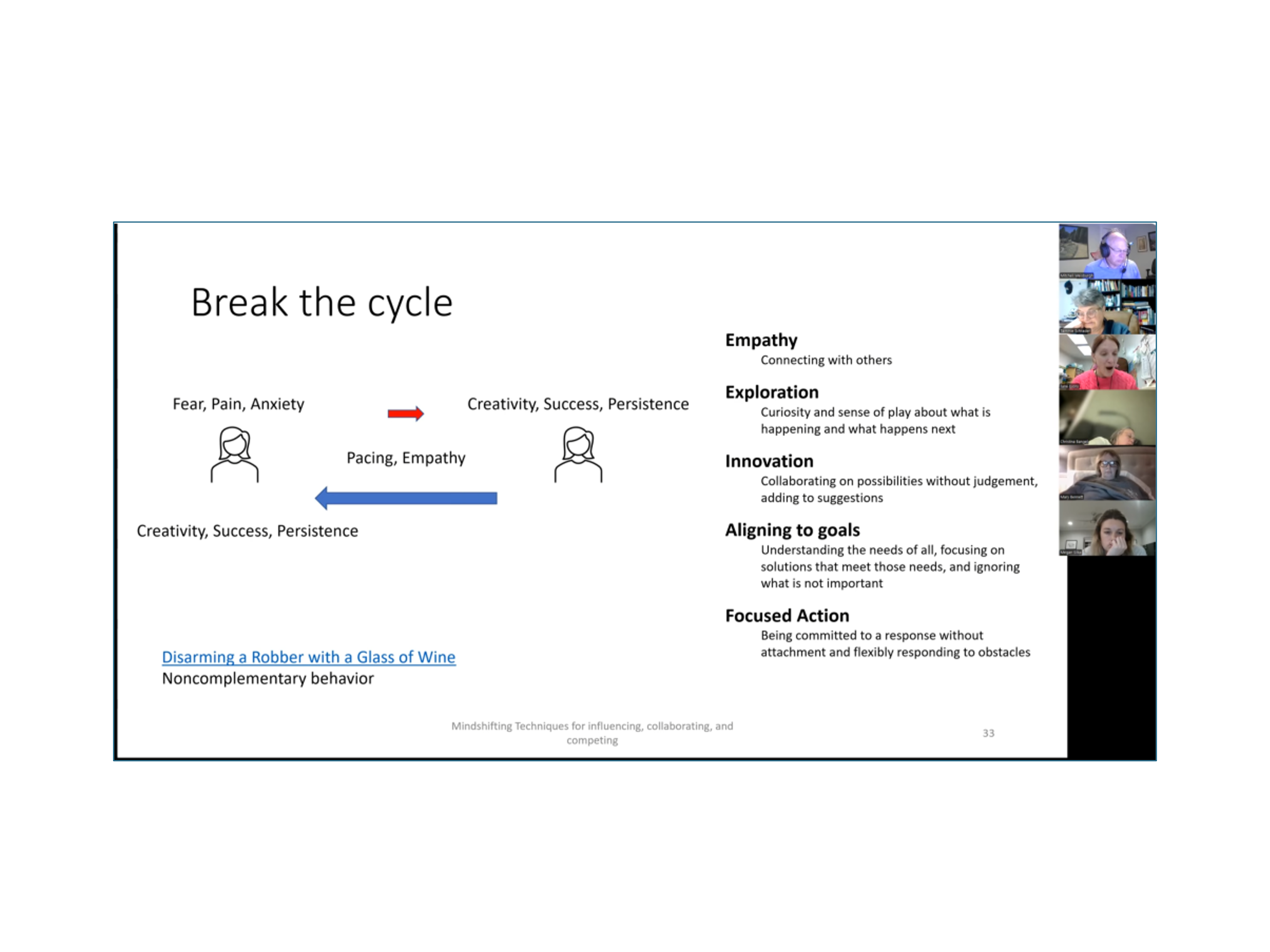
“If one person is angry, fearful, anxious, or in pain, and the other person responds with empathy, a sense of exploration or non-judgmental innovation, alignment to goals, perhaps resilient action or a combination of any of that. That person can often wear down the limbic actor and connect Sage to Sage brain.”
In practice, this means asking ourselves questions like, “Who do I want to be in this moment?” or “What would I love to happen as a result of this conversation?” As we become more adept at recognizing our triggers and intentionally shifting our responses, we not only deflect potential conflicts but also model a new way of interacting—one that is grounded in awareness, empathy, and genuine connection.
In short, one key to breaking the cycle of conflict lies in our ability to recognize the power of our own mirror neurons, and to consciously choose the state we wish to project. When we do, we invite others to join us in a more collaborative, compassionate, and creative space.
It all starts with our own self-awareness and desire to be exploratory in order to move forward.

Leave a Reply