Most of us grow up learning that conflict is something to avoid. We’re taught—implicitly or explicitly—that disagreement is dangerous, uncomfortable, or disruptive. It threatens harmony. It risks relationships. It makes everything harder.
But over the years, both in my work and in my own life, I’ve come to see something very different.
Conflict itself isn’t the problem.
In fact, conflict is inevitable anywhere human beings are trying to do something meaningful together—build a business, raise a family, lead a team, or change a system. Whenever values, goals, or perspectives collide, conflict shows up. The real question isn’t whether conflict will happen. It’s what happens inside us when it does.
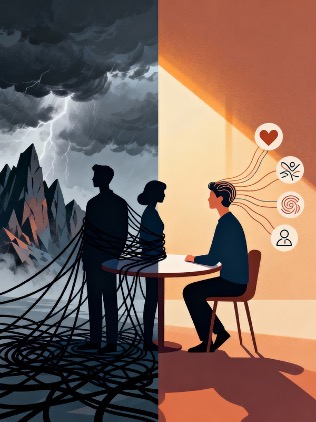
In Conflict and Collaboration, I draw a clear line between two fundamentally different kinds of conflict: destructive and constructive. From the outside, they can look almost identical—two people disagreeing, pushing back, or challenging each other. But internally, they’re driven by completely different brain states. And that difference determines whether conflict becomes a force for growth or a force for damage.
Destructive conflict comes from our survival brain—the limbic system. Constructive conflict comes from what I call the Sage mindset, where curiosity, humility, and resourcefulness are available to us. Learning to recognize the difference, and learning how to shift from one to the other, is one of the most powerful skills in the MindShifting toolkit.
What actually separates “good” conflict from “bad” conflict isn’t tone or politeness. It’s mindset.
When people hear the phrase “constructive conflict,” they often imagine something calm, restrained, or agreeable. But constructive conflict isn’t about being nice. It’s about being resourceful. It’s conflict that makes the situation better—often better than either person could have achieved on their own.
Destructive conflict, by contrast, emerges when the brain feels threatened. In that state, certainty replaces curiosity. Complexity collapses into binaries. The internal story becomes, “I’m right, you’re wrong,” and everything else gets filtered through that lens.
These differences aren’t about personality, upbringing, or communication style. They’re biological. When stress hormones like cortisol and adrenaline flood the system, the prefrontal cortex—the part of the brain responsible for empathy, creativity, and long-term thinking—goes offline. We don’t lose our intelligence, but we lose access to it.
That’s why destructive conflict spirals so quickly. Once we’re in survival mode, we default to fight, flight, freeze, fluency, or follow. We become more rigid. More reactive. Less capable of listening. And because our brains are wired with mirror neurons, we unconsciously amplify each other’s intensity. Limbic meets limbic, and the escalation feeds itself.
The outcomes are painfully predictable: resentment, avoidance, compliance without commitment, or outright hostility. The conflict doesn’t get resolved—it gets buried or weaponized.
Constructive conflict, on the other hand, emerges when we’re operating from Sage. In this state, the brain is supported by what I call the DOSE chemicals—dopamine, oxytocin, serotonin, and endorphins—which restore access to empathy, perspective, and innovation. From here, disagreement becomes productive rather than personal.
This is where the Five Sage Powers come online. We can see the other person as human rather than as a threat. We ask questions instead of defending positions. We generate new possibilities instead of recycling old arguments. We navigate decisions with an eye toward values and long-term impact. And we use feedback to adjust rather than to win.
In constructive conflict, the goal isn’t victory. It’s progress.
Here’s the part that surprises many people: it only takes one person to shift a conflict from destructive. You don’t need agreement. You don’t need permission. You need self-regulation.
True constructive conflict requires all parties to be in Sage mode, but one person can halt the destructive nature of the disagreement, and through that disruption often nudge the interaction toward building a better outcome.
The first step is interrupting your own limbic response. That means noticing the signals—rising anger, tightening certainty, defensiveness, or the anxious urge to prove something. When you catch those signals, you pause. You breathe. You reframe. You ground yourself using the tools we practice in MindShifting. This isn’t suppressing emotion; it’s choosing resourcefulness over reactivity.
The second step is what I call noncomplementary behavior. Destructive conflict thrives on matched reactions—anger meeting anger, certainty meeting certainty. When you respond with empathy or curiosity instead, you break the pattern. And because of mirror neurons, your calm and openness invite the other person’s brain to shift as well.
Once both people are more grounded, you can rebuild connection using collaborative tools—deep listening, thoughtful questioning, and clear, non-blaming expression of needs and requests. These approaches preserve agency. They prevent reactivation of survival responses. And they keep the conversation anchored in connection rather than control.
Conflict isn’t the enemy.
Survival mode is.
When we treat conflict as something to avoid, we miss its potential. But when we learn to shift ourselves—and then the interaction—into Sage, conflict becomes an asset. It strengthens relationships. It unlocks creativity. And it leads to outcomes neither side could reach alone.
Every time we choose Sage over limbic, we make that transformation more likely—not just in the moment, but in the culture we’re helping to create.
—
About MindShifting with Mitch Weisburgh
MindShifting is transforming how individuals, teams, and organizations unlock their full potential—whether in the classroom, the boardroom, or personal growth journeys. Developed by educator, author, and thought leader Mitch Weisburgh, MindShifting combines the latest insights from psychology, neuroscience, and practical experience to help people overcome barriers, shift mindsets, and achieve lasting results.
Through his writing, keynote talks, and engaging workshops, Mitch empowers educators, corporate teams, and life coaches to embrace new ways of thinking and problem-solving. His unique MindShifting framework provides practical tools for building resilience, resourcefulness, and collaborative skills that drive real-world change.
To continue your exploration of MindShifting, visit www.mindshiftingwithmitch.com.

Leave a Reply