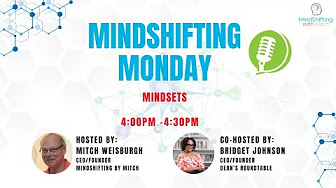
MindShifting Mondays with Mitch featuring Bridget Johnson
Every Monday afternoon, I show up live for MindShifting Mondays with Mitch with one simple purpose: to explore the invisible forces shaping how we think, react, lead, struggle, and grow. Sometimes I come solo. Sometimes I’m joined by a guest who brings this work to life in ways I couldn’t do alone.
This week, I had the privilege of being joined by Bridget Johnson, the founder of The Deans Roundtable, a professional development community devoted to student life leaders—the adults who serve as the relational anchors for students in schools and universities. And from the very first moments of our conversation, it became clear that Bridget doesn’t just understand leadership in theory. She lives at the intersection of mindset, fear, growth, and human connection every single day.
The full episode is embedded below this post, and I strongly encourage you to watch it. What follows here isn’t a replacement—it’s a glimpse into the heart of a conversation about how our survival brain quietly runs the show, and how we can learn to interrupt it with awareness, curiosity, and choice.
The Hidden Work of the Adults Who Hold It All Together
Speaking about what she see in her day-to-day, Bridget described ‘student life advisors’ as “a relational anchor for students.” These are the adults who help students feel seen, known, and supported. They track not just grades, but emotional well-being. They hold space for conversations about identity, belonging, responsibility, conflict, and decision-making—often during the most emotionally chaotic years of a young person’s life.
And when that system works well, students thrive.
But when it doesn’t, Bridget was clear about the consequences: students lose their sense of connection. They feel unseen. Unsupported. Alone. And as she put it, when advisory is inconsistent or poorly facilitated, students can internalize a devastating message—that they aren’t worth intentional care.
That’s not just an education issue. That’s a MindShifting issue. Because when people feel unseen, the survival brain takes over.
The Survival Brain Isn’t the Enemy—But It Runs on Fear
One of the most powerful moments in our conversation came when Bridget framed limiting mindsets as protective strategies of the survival brain. Fear of failure. Fear of judgment. Fear of saying the wrong thing. Fear of not belonging.
These are not character flaws. They are ancient safety mechanisms.
But when the survival brain is in charge, Bridget reminded us, learning, empathy, problem-solving, and connection all shut down. That’s true for students. It’s true for educators. It’s true for parents. And it’s absolutely true for leaders in the workplace.
This is where MindShifting lives—right at the moment when fear starts running the narrative.
Naming the Spiral Is the First Act of Power
Bridget shared one of the most practical tools I’ve ever heard for breaking a negative spiral: name the mindset out loud.
Not vaguely. Not gently. Specifically.
“This is fear of failure.”
“This is fear of being judged.”
“This is me thinking I don’t belong.”
As she put it, awareness interrupts the automatic survival loop. And once you name it, you can ask the next critical question:
What is this fear trying to protect me from?
That’s the moment where judgment dissolves into curiosity—the shift from reaction to response.
Why Micro-Habits Matter More Than Big Breakthroughs
From there, Bridget emphasized something that aligns perfectly with the MindShifting framework: this isn’t a one-and-done fix. It’s a practice.
Small practices. Micro-habits. Repeatable resets.
She talked about building simple regulation behaviors into daily life:
- Pausing to breathe
- Going for a short walk
- Listening to music
- Writing a quick list
- Interrupting negative self-talk with intentional reframing
Not massive life overhauls. Just small actions that calm the nervous system enough to let the prefrontal cortex—the part of the brain responsible for reasoning and empathy—come back online.
As Bridget beautifully put it, once the sweater of negativity starts to unravel, you have to catch the thread quickly.
Why Getting Out of Your Head Changes Everything
One of the most practical moments of the episode came when we talked about overwhelm. That familiar feeling of, “I have too much to do. I’ll never catch up.”
Bridget’s approach was refreshingly grounded:
Write the list. Put everything on paper. Look at it. Usually, it’s not as impossible as it felt inside your head.
And then—this part matters—don’t attack the whole list. Start with one small bite.
That’s not just productivity. That’s nervous system management. That’s survival brain de-escalation. That’s MindShifting in motion.
Leadership Without All the Answers
When I asked Bridget how she helps someone stepping into a new leadership role, she didn’t talk about power or control. She talked about curiosity, humility, and self-awareness.
Be excited about the work. Ask questions. Don’t assume. Don’t judge.
Surround yourself with people who know more than you do.
And perhaps most powerfully:
Know your own strengths—and how they fit with the group.
That’s not insecurity. That’s grounded leadership.
Bridget’s Three Core Takeaways
At the close of our conversation, I asked Bridget what she most wanted people to take with them. Her answers still echo with me:
- Everyone gets stuck in self-doubt and negative spirals at times. The key is stopping it early and replacing it with what you know is true about yourself.
- Other people are struggling too. When someone isn’t their best self, lead with curiosity instead of judgment.
- Pause. Breathe. Connect. Even one intentional moment of presence can change everything.
Why This Conversation Matters
What moved me most about this episode wasn’t just the insight—it was Bridget’s deep reverence for the people she serves. The advisors. The educators. The leaders. The students. The humans inside the system.
She sees their fear. Their exhaustion. Their emotional labor. And she meets it with compassion, structure, and tools for growth.
Bridget, I am deeply grateful for your work—and for your voice in this conversation.
🎥 Watch the full MindShifting Mondays with Mitch episode featuring Bridget Johnson below.
You’ll hear her insights in her own words, and I promise—it’s worth your time.
And as always, we’re live every Monday at 4:00 PM Eastern on LinkedIn and Substack. If you’re navigating fear, leadership, conflict, or uncertainty—this space is for you.
Let’s keep shifting.
Mitch

Leave a Reply