Have you ever found yourself mid-argument thinking, “Why am I saying this?” If so, welcome to the human race.
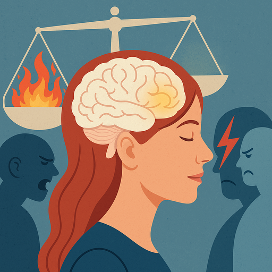
When tension rises, a very old part of our brain — the limbic system — takes over. It’s fast, emotional, and determined to keep us safe. That part of our brain is miraculous, but it’s also wired for survival, not diplomacy.
Unfortunately, the limbic or survival brain is terrible at resolving disagreements. You see, the limbic brain has not evolved from its original programming; it reacts to something subtle like a harsh tone, a frown, or a difference of opinion in the same way it once reacted to saber-toothed tigers: danger detected!
Your pulse quickens, your breathing shortens, and suddenly your body is preparing for battle instead of conversation. You might raise your voice, shut down, or start rehearsing comebacks instead of listening. And the person you are interacting with? Their limbic brains are having the same effects on them.
Sound familiar? Sound frustrating?
You have become victim to what I call the Limbic Hijack — and it’s one of the central ideas I unpack in my upcoming book, Conflict and Collaboration: MindShifting with Mitch (Volume 3), coming this December. Interested in an advance copy? Read on!
The Good News: There’s Another Brain on Call
Just above that ancient limbic system sits a more evolved partner, the prefrontal cortex, or what I like to call the Sage Brain.
Here is where logic, empathy, and perspective live.
But there is a catch: the Sage Brain can’t do its job while the limbic system is running the show.
Stress literally shuts it down. That’s why we often say things we don’t mean — or forget the perfect, reasonable response only after the argument ends.
The key isn’t to get rid of emotion, emotions are helpful messengers, and we couldn’t do that in any case. The key is to notice when your limbic brain has taken over and give your Sage Brain time to clock back in.
A deep breath, a short pause, or even labeling what you’re feeling (“I’m frustrated”) signals safety to your nervous system. In that moment, your body can move from fight-or-flight back to think-and-consider. That’s when collaboration becomes possible again.
Where This Fits in the Bigger Picture
In Conflict and Collaboration, this idea forms the foundation for everything that follows. Once we understand how our brains react under stress, we can start to make conscious choices about how we show up — as parents, partners, teammates, and citizens.
From there, the book explores tools like Motivational Interviewing and Nonviolent Communication, which build on that same awareness to turn friction into forward motion.
But it all starts here: learning to stay calm enough to think clearly, connect honestly, and act wisely.
It’s learnable with practice, and the science proves it.
Your MindShift Challenge
The next time you feel tension rising — in a meeting, at home, or even online — try this experiment:
- Notice what’s happening in your body.
- Name it silently (“This is my limbic brain talking.”)
- Take one slow breath before you respond.
That feeling of relief after the tiny pause may be your Sage Brain’s way of saying, “Thanks for inviting me back into the conversation.”
Conflict and Collaboration: MindShifting with Mitch (Volume 3) will be available this December 2025.
👉 To learn more about the book — and how you can join the Book Launch Team for early access and exclusive updates — visit www.mindshiftingwithmitch.com/volume3.
Stay calm, stay curious, and keep MindShifting.
— Mitch Weisburgh
– —
About MindShifting with Mitch Weisburgh
MindShifting is transforming how individuals, teams, and organizations unlock their full potential—whether in the classroom, the boardroom, or personal growth journeys. Developed by educator, author, and thought leader Mitch Weisburgh, MindShifting combines the latest insights from psychology, neuroscience, and practical experience to help people overcome barriers, shift mindsets, and achieve lasting results.
Through his writing, keynote talks, and engaging workshops, Mitch empowers educators, corporate teams, and life coaches to embrace new ways of thinking and problem-solving. His unique MindShifting framework provides practical tools for building resilience, resourcefulness, and collaborative skills that drive real-world change.
To continue your exploration of MindShifting, visit www.mindshiftingwithmitch.com.

Leave a Reply