Remember that old saying, “monkey see, monkey do;” well, it proved truer than was predicted.
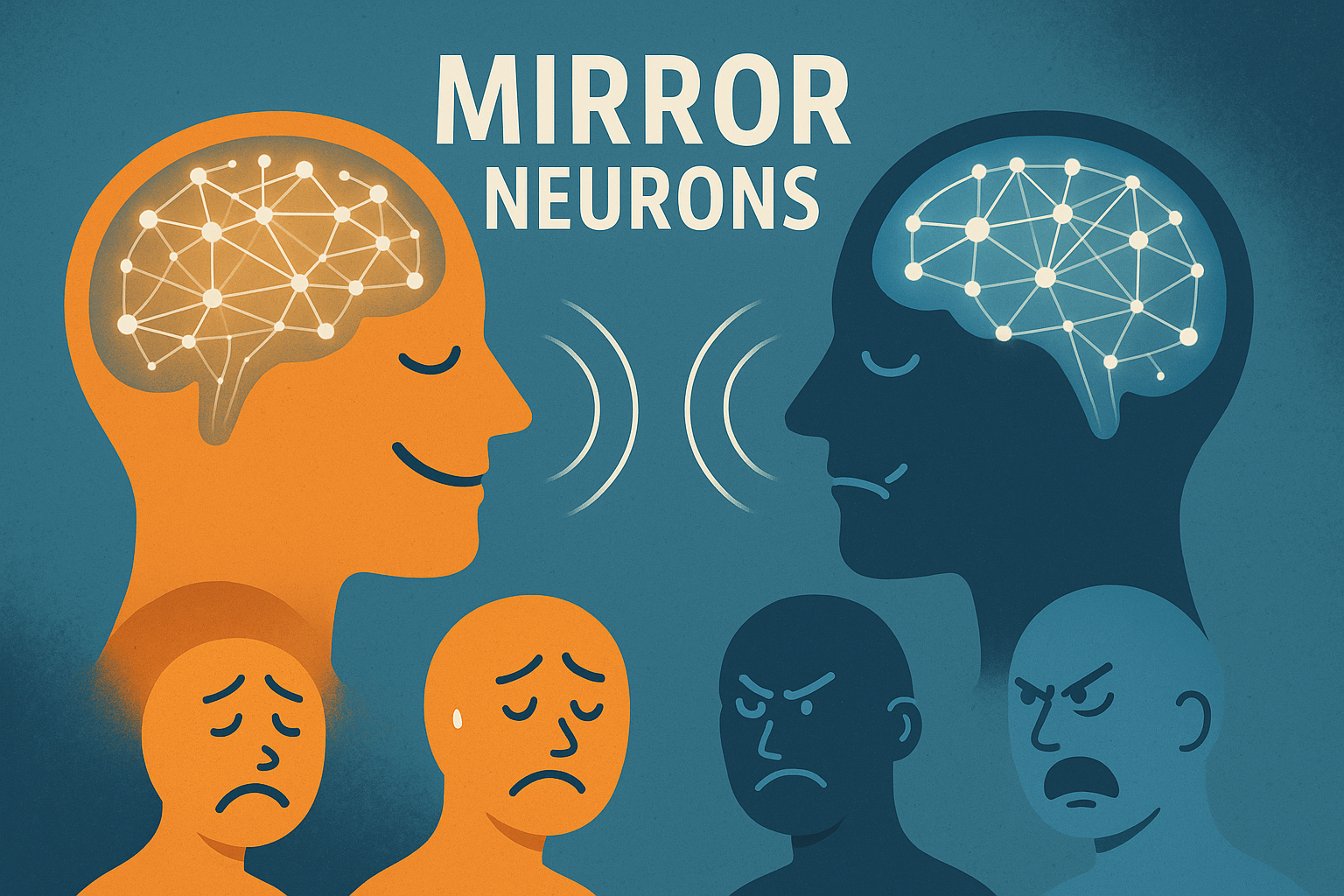
When humans (and primates) see or hear an action, to their brain, it is just like they are performing the action themselves. The tiny cells responsible for this remarkable reaction are mirror neurons, aptly named for mirroring observed actions through the chemical pulses they give off. Mirror neurons account for babies’ ability to learn to move, walk, and talk. They also explain why most people respond better to demonstrations than instructions.
In 1980, Leonardo Fogassi and Vittorio Gallese of the University of Parma made a revolutionary observation. One’s brain reacts the same way watching someone else do something as when he is performing the action himself. This breakthrough discovery was not fully appreciated until 2000, when V.S. Ramachandran introduced the discovery to the forefront of science. Many experiments on primates and humans later, most of the scientific community has recognized the existence and purpose of mirror neurons.
We are social
If humans were not social creatures, we would still have digestive and motor systems, but mirror systems only become useful in social beings. In order to take advantage of mirror neurons, therefore, it is necessary to be in a social setting, not by yourself. Mirror neurons explain the appeal of watching sports, because if you know the sport, you are actually living through the game with the athletes themselves, explaining reactions like winces, increased energy levels, excitement, anger, and frustration. In a neuro-typical brain (since there is evidence of problems with the mirror neurons in people with autism, this would obviously not apply), utilizing techniques to maximize mirror neuron stimulation could have a positive impact on social skills.
The act of laughing in itself has the ability to cheer someone up; it can be a powerful tool. Inversely, a frown and a sulk have the opposite reaction. As a social being, humans have developed a copycat impulse. Peer pressure can simply be from watching. If one person is eating, others around may get hungry just from watching, because they have the impulse to eat. A good way to encourage behavior is to do.
Positive effects of mirror neurons
Not only is there evidence that empathy is directly linked to the mirror system, basic human interaction, understanding, intuition, social behavior, relationships, and caring may develop from mirror neurons.
We know that when a person is around others who are happy, creative, successful, or persistent, that person is also more likely to be happy, creative, successful, and persistent, which then reinforces those qualities in the first person which further reinforces those qualities and so on in a positive feedback loop.
If we are in a resilient, sage frame of mind, that often results in others mimicking that same resilient sage mindset.

Mirror neurons spawn:
- Our abilities to learn new skills
- Empathy
- Language acquisition
- Belonging and bonding
- Cooperation and Collaboration
Not so positive effects of mirror neurons
We also know that when a person is around others who are fearful, angry, in pain, or anxious, that person’s mirror neurons give rise to fear, anger, anxiety, and pain which then amplifies those traits in the first person which trigger more of the same and so on, also in a positive feedback loop.

Mirror neurons thus also leverage:
- Contagious anxiety, fear, anger
- Group pressure
- Unhealthy behaviors
- Exposure to negative media
- Mob mentality
- Prejudice or discrimination
If I sense you are angry at me or that you are threatening me, I will be angry at or threaten you back.
We see this so often when we give advice to people. Our advice is taken as a condemnation, threat, or attack by the other person, and they get angry at us. We then react with anger. We are just in essence being controlled by our mirror neurons.
We can turn that around
Whereas the natural tendency is to respond with our survival or limbic brains, anger to anger, attack to attack, fight to fight, we can learn to break the cycle.
If one person is angry, fearful, anxious, or in pain, and the other person responds with empathy, a sense of exploration, non-judgmental innovation, alignment to goals, perhaps resilient action or a combination, that person can often wear down the limbic-brained actor, lighting up their mirror neurons and connecting sage to sage.
Sometimes our first reaction is limbic, perhaps anger. If we are conscious that we are in limbic or survivor mind, we can reset to Sage.

If we want to interact in resourceful or sage mode, the key is to first be aware, we are in a discussion or interaction and are reacting limbic to limbic, and second to ask yourself, “how can I break that?”
We can even make a game out of it:
- Can we stay in sage mode with 10 responses even if the other person continues to respond with anger or fear?
- Who can maintain their state longer, me in sage or them in limbic?
I dare you to try it and comment back on how it worked.
—
About MindShifting with Mitch Weisburgh
MindShifting is transforming how individuals, teams, and organizations unlock their full potential—whether in the classroom, the boardroom, or personal growth journeys. Developed by educator, author, and thought leader Mitch Weisburgh, MindShifting combines the latest insights from psychology, neuroscience, and practical experience to help people overcome barriers, shift mindsets, and achieve lasting results.
Through his writing, keynote talks, and engaging workshops, Mitch empowers educators, corporate teams, and life coaches to embrace new ways of thinking and problem-solving. His unique MindShifting framework provides practical tools for building resilience, resourcefulness, and collaborative skills that drive real-world change.
To continue your exploration of MindShifting, visit www.mindshiftingwithmitch.com.

Leave a Reply