What if It’s the Brain?
Guest post by Bridget Johnson
Bridget Johnson is the Founder of The Deans’ Roundtable—a thriving professional development community where student life leaders connect, collaborate, and innovate. Over the past decade, we’ve grown from a one-off conference into a nationwide movement empowering deans and student affairs professionals across independent schools.
The Conversation Schools Aren’t Having Enough
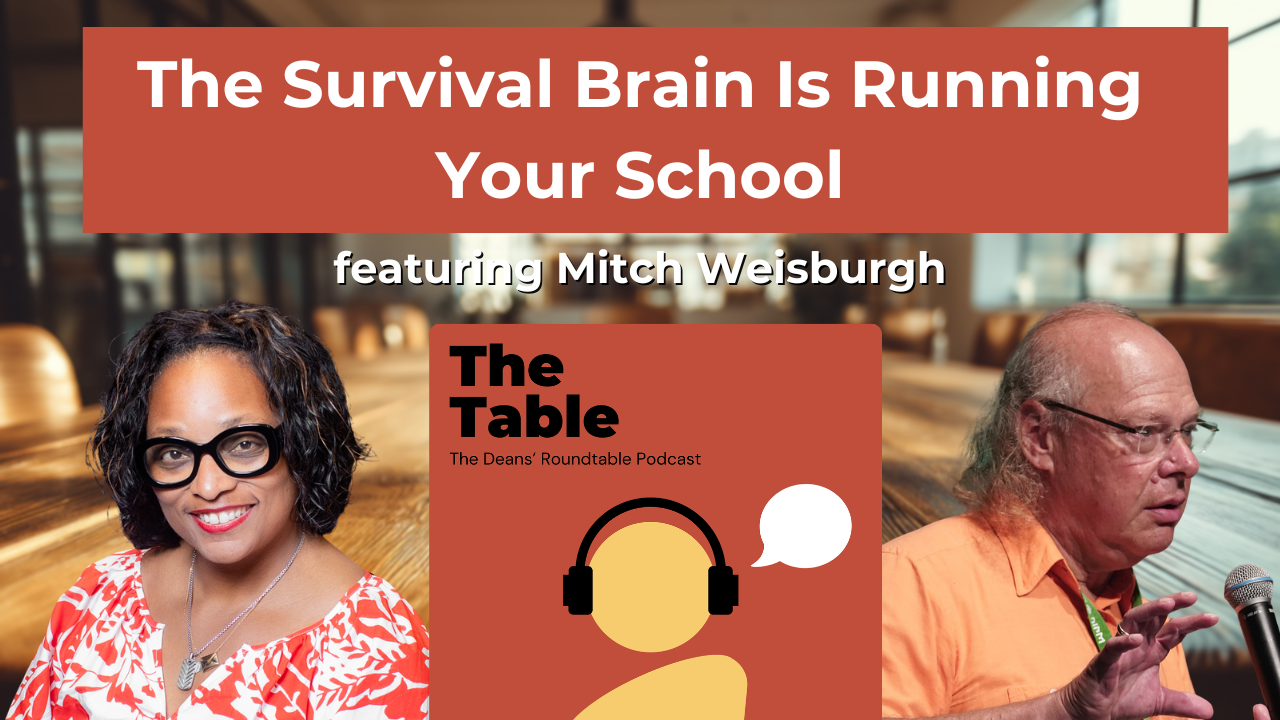
In a recent episode of The Table, I sat down with Mitch Weisburgh, an educator, author, and founder of the Mindshifting Community. Mitch is also the author of two books: Mind Shifting: Stop Your Brain from Sabotaging Your Happiness and Success and his second, MindShifting: Conflict and Collaboration, released in December 2025.
What we discussed goes beyond the usual conversation about educator wellness or student behavior. It gets at something more fundamental: the way our brains operate under pressure, and how learning to recognize that can change everything from how we lead a faculty meeting to how a student handles a classroom conflict.
This is a conversation worth having in every school, at every level.
What Is Mind Shifting, Exactly?
Mitch described mind shifting as a framework built on three pillars that he identified after drawing from fields as varied as neuroscience, economics, psychology, and coaching:
- Resourcefulness: Knowing how to work with your brain rather than against it when it defaults to limiting reactions
- Resilience: Understanding that a first attempt that doesn’t work is feedback, not failure
- Collaboration: Building genuine skills for working through disagreement and conflict, not just around it
The framework grew from Mitch’s experience in education technology, where he spent years watching schools adopt tools and programs that still weren’t producing kids prepared for adult life. He eventually developed a two-day workshop for college students on how successful people make sense of difficult situations, and the response was immediate. Students who walked in resigned to certain ways of thinking left feeling that they actually had more power than they realized.
That insight is worth sitting with, especially when we think about what we’re trying to build in schools.
The Survival Brain vs. The Sage Brain
One of the most useful frameworks Mitch shared is the way he divides brain function into two modes: the survival (or limbic) brain and the resourceful brain, which he calls the sage brain.
The survival brain reacts in roughly two hundredths of a second. It’s fast, efficient, and designed to protect us. It operates through what Mitch calls the “five F’s”: fight, flight, freeze, fluency (automatic habitual responses), and following (mirroring the behavior of those around us). He also raised the possibility of a sixth: fawn, the impulse to over-please as a protective response.
The sage brain, located in the prefrontal cortex, takes two to three seconds to come online. It’s where curiosity, creativity, empathy, and reasoned decision-making live.
Here’s the problem: the survival brain often has already decided what to do and is using the sage brain to rationalize that decision, not actually make it. For educators, this shows up constantly. A teacher who “knows” a student is a problem. An administrator who “knows” how a conversation is going to go. A leader who reacts before pausing to ask what they actually want to happen.
The shift Mitch describes isn’t about suppressing those survival reactions. It’s about recognizing them for what they are, and then creating just enough space to ask: is this really the only option here?
What Limiting Mindsets Look Like in Schools
Mitch shared a list of 14 internal statements that signal a person is not in a collaborative mindset. A few of them:
- “I know what they should do.”
- “They’re challenging my authority.”
- “They don’t listen to me.”
- “It’s their fault.”
- “I’ll just be quiet and do what I want anyway.”
- “I shouldn’t say anything because it will only make things worse.”
Reading through that list, it’s easy to nod and recognize those thoughts as common. What Mitch is pointing out is that these aren’t character flaws. They’re signs that the survival brain has taken over and is running the show. The first step isn’t to feel shame about them but to notice them.
That noticing is where the shift becomes possible.
For Educators Who Are Running on Empty
The most candid part of the conversation was about burnout, and Mitch didn’t downplay it. His framing was refreshingly honest: burnout in education isn’t a personal failing. It’s a predictable result of operating in a system that isn’t aligned with what most educators actually want education to do.
His advice to burned-out teachers was direct: first, recognize that what you’re feeling isn’t unique to you and isn’t a sign that something is wrong with you. Second, find moments of calm outside of fight-or-flight mode, whether through meditation, a walk, or whatever genuinely works for you, and from that calmer state, ask yourself what you truly want. The answers might lead to adaptation, to finding small pockets of joy within a constrained system, or in some cases, to the decision to leave entirely. What matters is that the decision comes from a place of clarity and self-knowledge rather than reactive exhaustion.
He also made a point that I think deserves attention: when school leaders think about who needs support, the adults in the building often get left out. The assumption seems to be that professional adults should already have the tools to regulate, collaborate, and persevere. But Mitch’s work starts with educators precisely because students can only benefit from what the adults around them are actually modeling.
Building Collaboration That Actually Works
Mitch’s second book takes on conflict directly, and the core argument is worth understanding: conflict, handled with the right tools, produces better outcomes than its absence. Diversity of viewpoints creates friction, but it also generates better solutions. The goal isn’t to minimize disagreement but to get better at moving through it.
The three approaches he recommends as foundational for anyone working in schools are:
- Strength-based feedback: Leading with what’s working, which disarms defensiveness and makes people more open to what needs to change
- Motivational interviewing: Drawing out a person’s own reasoning and goals, rather than trying to convince them of yours
- Nonviolent communication: Phrasing requests in ways that acknowledge needs without triggering threat responses
These aren’t new concepts, but what Mitch offers is a way to understand why they work, rooted in how the brain actually processes interpersonal interactions. When people understand the mechanism, they’re more likely to use the tool.
Starting With Students: Any Age, Any Classroom
One of the questions I was curious about was how young students can meaningfully engage with these concepts. Mitch’s courses serve educators from pre-K through community college, and over the years, they’ve built a library of more than 150 lesson plans adapted for different grade levels. Approximately 40 of those include short video explanations for teachers on how to implement them.
The vocabulary he recommends teaching students includes recognizing “big emotions,” understanding what it feels like to be in survival mode, and learning concrete techniques to calm the nervous system before trying to reason through a situation. For younger students, the language is simplified, but the underlying skill is the same one adults need: the ability to notice what’s happening internally before reacting.
Crucially, this mirrors the same process educators need to practice themselves. You can’t guide students toward self-regulation while operating in survival mode.
Change Doesn’t Have to Be Systemic to Be Meaningful
One of the more grounded parts of the conversation was Mitch’s take on how real change in education actually happens. He’s skeptical of top-down mandates, and he’s equally skeptical of waiting for the whole system to shift before doing anything differently in your own classroom or school.
He described what he called “islands of coherence,” a concept drawn from a school turnaround example he writes about in his book involving a principal in Portugal. Unable to fire or discipline resistant teachers, she invested deeply in a small cohort of six or seven educators who were already aligned with a better way of working. She gave them extra resources, extra support, and a weekly meeting. The next year, the cohort expanded. The year after, it expanded again. Within four years, the culture of the school had changed significantly, driven by teachers who saw what was possible and wanted in.
The lesson for school leaders isn’t to give up on structural change. It’s to recognize that structural change often begins with a small group of people who refuse to wait for it.
One Thing to Take Into This Week
Mitch closed with something simple, and I think it’s worth repeating: the problems we face and our reactions to them originate in our own minds, not just in the situations themselves. That doesn’t mean the situations aren’t real or that the challenges aren’t genuine. It means that when we’re feeling stuck, frustrated, or certain there’s no good option, that’s often a signal from the survival brain, not an accurate read of reality.
The shift begins with noticing that. From there, the tools can follow.
You can find Mitch and his work at MindShiftingWithMitch.com, where you can also subscribe to his free newsletter. His courses are currently available free to educators in New York and Washington, with plans to expand to other states.

Leave a Reply