
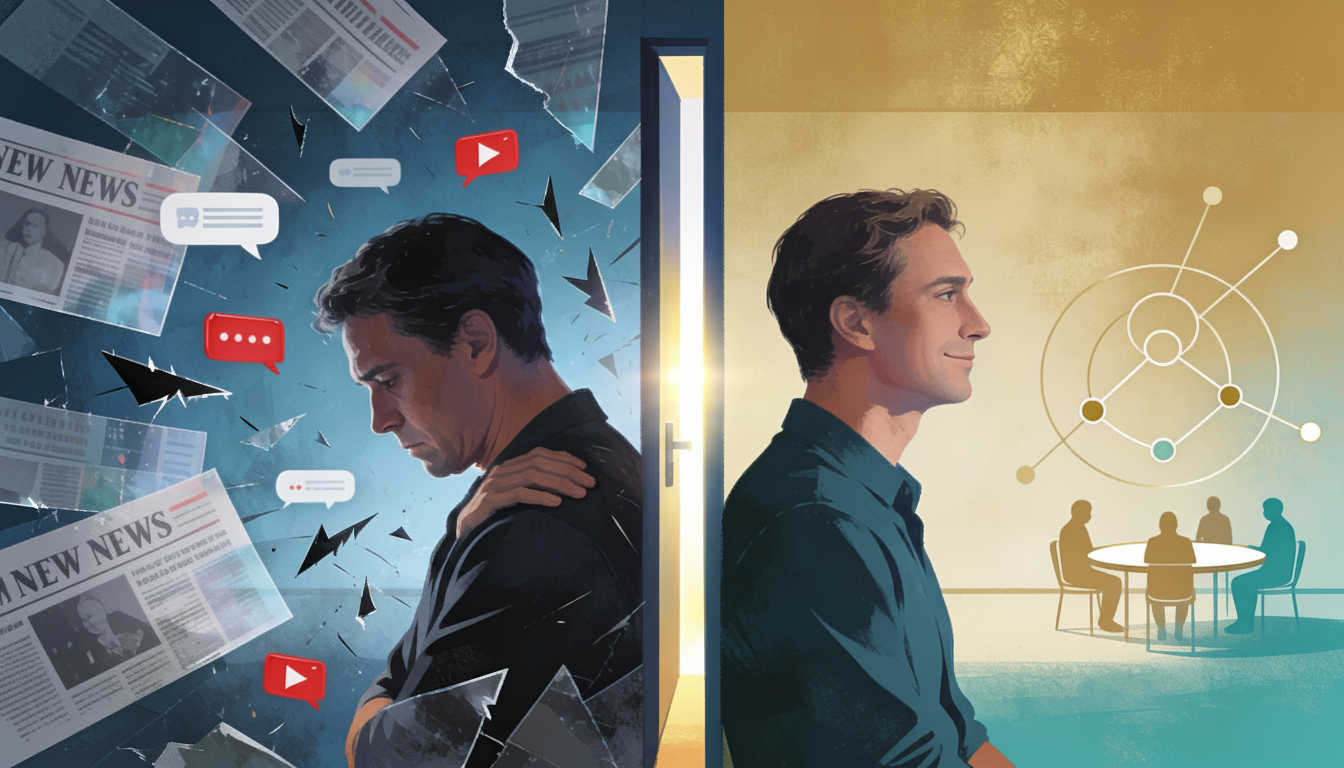
We are living in a moment of constant threat perception.
Everywhere we turn, our brains are being fed signals of danger. Political polarization. Economic uncertainty. Social fragmentation. A 24-hour news cycle engineered to keep us activated. Algorithms that reward outrage and amplify conflict because it holds our attention longer than calm or nuance ever could.
We are wired for protection, and the modern world has become extraordinarily effective at convincing us that protection is our only option. So our nervous systems stay on high alert. Our shoulders tense. Our thinking narrows. We scan for enemies, not possibilities.
The default response is reactive. We fight. We flee. We freeze. Sometimes we comply outwardly while shutting down internally. We defend our positions. We harden our certainty. We dehumanize the people who disagree with us—not because we’re cruel, but because our brains have decided they might be dangerous.
This isn’t a moral failing. It isn’t a character flaw.
It’s human.
Cognitive Science tells us that our limbic systems are doing exactly what they evolved to do: detect threats and move us toward survival. Here is the problem:
- The limbic system is binary; something is a threat or it’s not a threat. Something that may tire us out is a threat, something that would kill us is a threat.
- It’s designed to steer us around immediate threats.
- The instincts that would keep us alive in the short term can quietly destroy what matters most in the long term.
- The stress hormones that keep us alert and focused on danger in the short term, can erode our health and resourcefulness over the long term.
When we live in chronic survival mode, relationships erode. Teams stall. Families fracture. Communities polarize. The capacity to collaborate—especially with people who think differently than we do—shrinks. We become very good at being right and very bad at being resourceful. We focus on the disagreement or conflict, and we lose the end goal.
Somewhere along the way, we forgot how to disagree without dehumanizing. We forgot how to stay connected while holding different perspectives. We forgot how to move forward together when there isn’t easy agreement.
This is the cultural moment we’re in.
And it’s exactly why MindShifting exists.
MindShifting isn’t therapy. It isn’t motivational speaking. It isn’t about being nice or avoiding conflict. It’s a practical framework for interrupting our automatic reactions and reclaiming choice in moments that matter.
At its core, MindShifting creates space; a small but powerful space between what happens and how you respond. That pause is transformational. Because inside it, you’re no longer trapped by your limbic programming. You have options again.
The first shift is awareness. Simply recognizing that your brain is doing what it’s wired to do changes the entire equation. Threat responses are automatic, not personal. You’re not broken. You’re human. And once you understand that, shame, anxiety, overwhelm, and fear all loosen their grip and curiosity becomes possible.
From there comes the strategic pause. In a tense conversation. In a stressful decision. In the middle of conflict. Instead of reacting in ways that blunt your effectiveness or escalate the situation, you pause just long enough to ask better questions: What is actually possible here? What do I really want? What would I or we enjoy?
We fear that that pause will make us passive. But the pause makes us strategic.
And from that space, three mindsets become available—mindsets that are not personality traits, but learnable skills.
Resourcefulness asks, What can I do? What options exist that I haven’t considered yet?
Resilience asks, What can I learn from this? How can this experience strengthen rather than diminish me?
Collaboration asks, How can we move forward together, even if we don’t fully agree?
When you shift into these mindsets—especially under pressure—everything changes. You see options that were invisible before. You hear information you would have filtered out. You discover that people you thought you couldn’t work with may be more reachable than you imagined.
This isn’t theoretical.
We’ve tested this framework in real-world environments: workplaces, families, schools, faith communities, leadership teams, and civic groups. People use it. It works. And the changes aren’t subtle. Conversations soften. Decisions improve. Relationships repair. Momentum returns.
What’s at stake here is bigger than individual success.
We are facing a crisis of conflict literacy.
We teach people how to read and write. We teach math, science, history, and technology. But we rarely teach how to navigate disagreement, how to collaborate under pressure, or how to stay grounded in the presence of difference.
The cost of that gap is everywhere. Teams paralyzed by internal tension. Families unable to talk across political or generational divides. Communities stuck because they can’t have real conversations. Institutions failing because collaboration has become impossible. Political parties locked into battles for power.
MindShifting doesn’t claim to solve everything. But it addresses something foundational. It builds the internal capacity that makes everything else—leadership, innovation, problem-solving, governance—possible.
And here’s what makes this moment different.
The cultural need is undeniable. The framework is proven. And for the first time, the infrastructure exists to scale these skills in a meaningful way.
We don’t need to eliminate conflict. We need to learn how to engage with it without surrendering our humanity.
That’s the work of MindShifting.
And there has never been a more important time to do it.
—
About MindShifting with Mitch Weisburgh
MindShifting is transforming how individuals, teams, and organizations unlock their full potential—whether in the classroom, the boardroom, or personal growth journeys. Developed by educator, author, and thought leader Mitch Weisburgh, MindShifting combines the latest insights from psychology, neuroscience, and practical experience to help people overcome barriers, shift mindsets, and achieve lasting results.
Through his writing, keynote talks, and engaging workshops, Mitch empowers educators, corporate teams, and life coaches to embrace new ways of thinking and problem-solving. His unique MindShifting framework provides practical tools for building resilience, resourcefulness, and collaborative skills that drive real-world change.
To continue your exploration of MindShifting, visit www.mindshiftingwithmitch.com.

Leave a Reply