
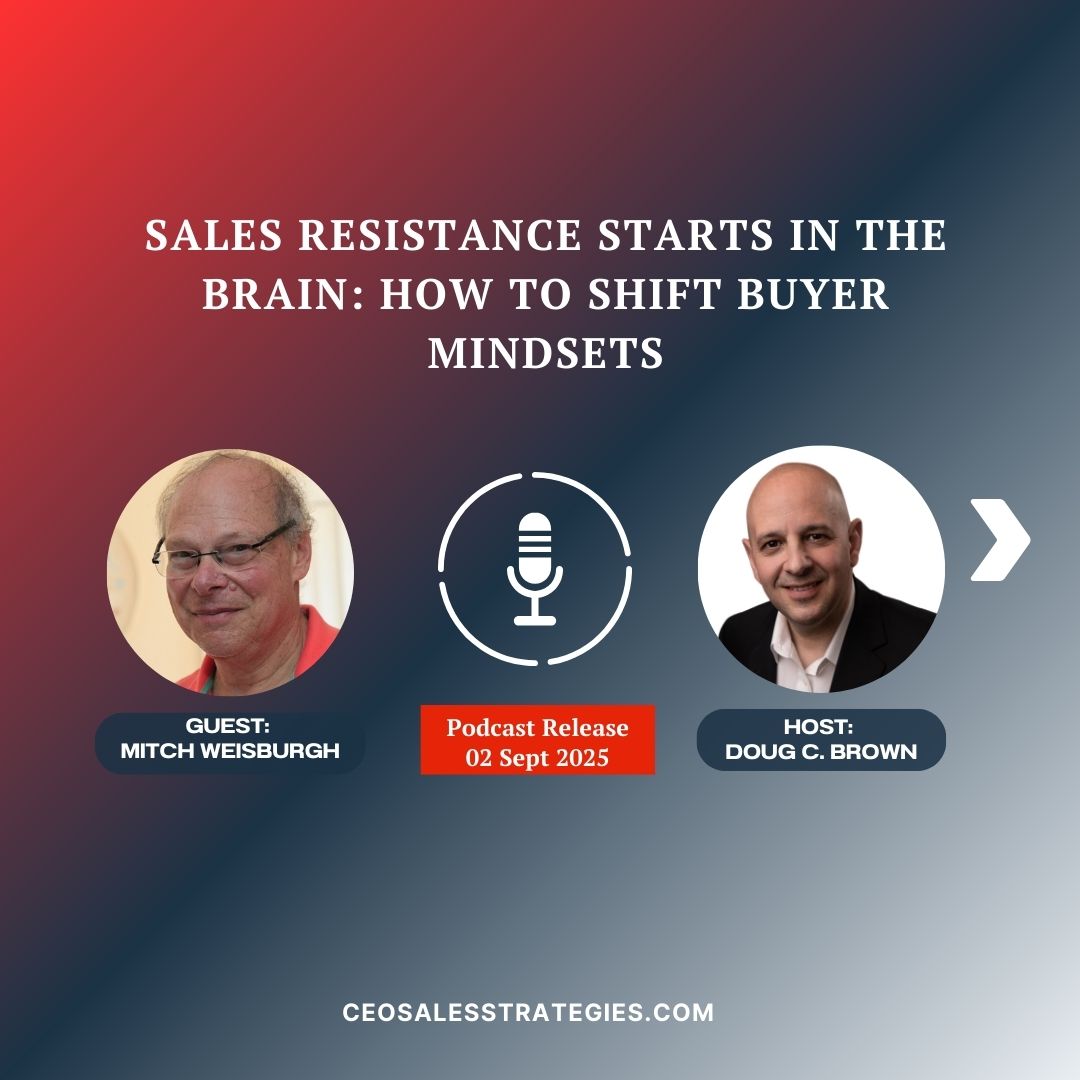
I recently had the privilege of sitting down with Doug C. Brown and his terrific podcast, CEO Sales Strategies to discuss the role (and potential) of MindShifting in the sales process.
Here is his own summary of our wide ranging conversation (audio links and embedded video, below):
Sales Resistance Starts in the Brain: How to Shift Buyer Mindsets
Sales objections often have less to do with pricing or timing and more to do with how the brain processes fear and uncertainty. In this episode, discover why the limbic system sabotages deals before logic kicks in, and how understanding buyer psychology helps you guide prospects out of resistance and into clarity. Learn the five brain-based responses to perceived threats, how to shift stalled conversations with neuroscience-based techniques, and what it really takes to become a more influential sales leader by interrupting your own limiting mental patterns.
Key Highlights
- Why Sales Resistance Begins in the Brain
- How Buyers React Before Logic Even Engages
- Understanding the Five Survival Responses in Sales
- The Real Reason Objections Are Emotional, Not Rational
- Techniques to Shift Buyers Out of Fear
- Why Certainty Often Blocks Better Business Decisions
- How Leaders Can Interrupt Sabotaging Thought Patterns
Summary
1. Why Sales Resistance Begins in the Brain
Sales resistance often originates in the limbic system — the brain’s emotional center that reacts before logic engages. This system is wired for survival, scanning for threats and triggering a “no” long before a buyer considers the value of an offer. Resistance isn’t necessarily about price or need — it’s often about discomfort, uncertainty, or perceived danger. Recognizing this gives sales professionals a powerful edge. By shifting from persuasion to understanding, sales conversations become less about overcoming objections and more about guiding buyers through fear into clarity. It starts with addressing biology, not logic.
2. How Buyers React Before Logic Even Engages
When information enters the brain, the first responder is not logic but emotion. The limbic system processes stimuli in milliseconds, scanning for danger based on minimal data. If it senses threat — confusion, pressure, or change — it reacts instantly with emotional defenses. This happens before the rational mind has time to assess or respond. In sales, this means the objection may be forming before the pitch is even finished. Without awareness of this automatic process, sellers often misinterpret fear as disinterest. Calming the buyer’s emotional response first opens the door for true decision-making. When buyers object, it’s not always about logic — it’s often fear driving the response. ~ Doug C. Brown Share on X
3. Understanding the Five Survival Responses in Sales
Sales resistance often takes one of five survival-based forms: fight, flight, freeze, habit, or mimicry. These are the brain’s default behaviors when it perceives uncertainty or pressure. Buyers may lash out, retreat, stall, rely on routine, or conform to group norms — all subconscious strategies to avoid perceived risk. Understanding these five responses gives sales professionals a framework to decode seemingly irrational behavior. When sellers respond to resistance without knowing which response is active, they risk increasing tension. But when they match their strategy to the brain’s real concern, they can disarm resistance and restore clarity.
4. The Real Reason Objections Are Emotional, Not Rational
Objections are rarely about what they seem. Beneath common phrases like “too expensive” or “not the right time” is an emotional process fueled by fear, uncertainty, or risk aversion. The brain defaults to emotional judgment before reasoning takes over, often locking in resistance before the full offer is processed. That’s why logical counterpoints so often fall flat — the issue isn’t the pitch, it’s the protective reaction already in place. The key to handling objections effectively is recognizing their emotional roots and creating safety, not arguing details. Emotional intelligence is more important than rebuttals.
5. Techniques to Shift Buyers Out of Fear
Shifting a buyer from fear to engagement requires more than facts — it takes a deliberate reset of their emotional state. Start by recognizing the fear-based response and slowing the interaction. Use calm tone, open-ended questions, and space to allow the prefrontal cortex — the logical brain — to engage. Avoid pushing or over-explaining; instead, create a pause that interrupts the automatic pattern. Ask reframing questions like, “What would need to happen to feel more confident?” or “What concerns are showing up right now?” These approaches foster curiosity and control, making space for a more grounded conversation.
6. Why Certainty Often Blocks Better Business Decisions
The feeling of certainty can be deceptive. In fact, when someone is completely sure of something — especially during conflict or stress — it often signals that the emotional brain has taken over and shut down the possibility for new information. Certainty is a protective mechanism, not necessarily a sign of truth. In sales and leadership, holding onto certainty can blind decision-makers to better options or collaboration. By challenging the impulse to be right and asking, “What might I be missing?”, leaders and salespeople reopen creative pathways and avoid rigid, emotionally driven choices that limit growth.
7. How Leaders Can Interrupt Sabotaging Thought Patterns
Procrastination, emotional reactivity, avoidance — these common challenges often stem from outdated mental wiring, not lack of skill. The brain defaults to patterns that feel safe, even when they sabotage results. Leaders who understand how these loops form can introduce “pattern interrupts” to break the cycle. That might include pausing before responding, reframing the situation with open-ended questions, or recognizing when emotional certainty is distorting perspective. The shift starts with awareness and grows through practice. Over time, teams trained in self-awareness and pattern interruption build resilience, make better decisions, and reduce emotional drag in the business.
Take the Next Step Toward Business Growth:
If this episode resonates with you, subscribe to the CEO Sales Strategies Podcast for insights into growing your business, improving sales strategies, and achieving predictable growth.
- Are fear-based objections slowing down your sales cycle?
- Could your team be missing deals because they trigger the wrong brain response?
- What mental patterns might be holding your company back from growth?
Find the episode at these links, or watch the video, below:

Leave a Reply